PKSB (Parking Support Brake)
Parking Support Brake function (rear-crossing vehicles)Parking Support Brake (PKSB)
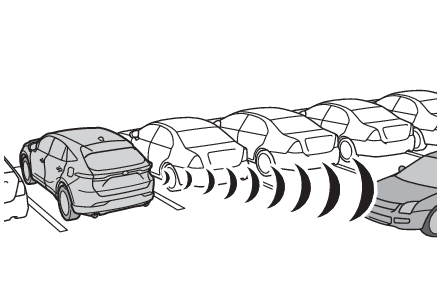
Parking Support Brake function (rear-crossing vehicles)Parking Support Brake function (rear-crossing vehicles)**If equippedIf a rear radar sensor detects a vehicle approaching from the right or left at the
rear of the vehicle and the system determines that the possibility of a collision
is high, this function will perform brake control to reduce the likelihood of an impact
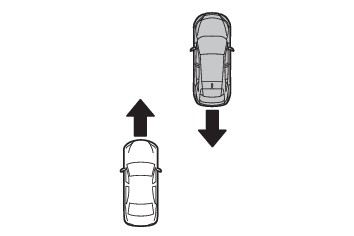
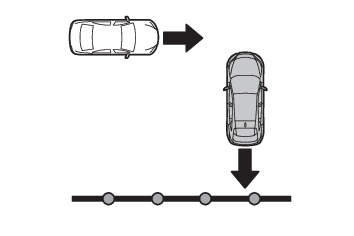
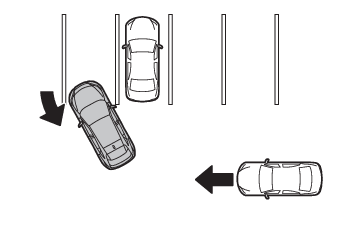
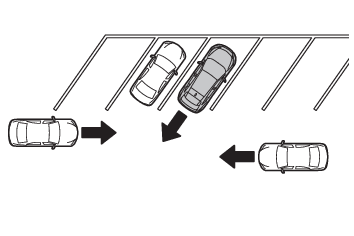
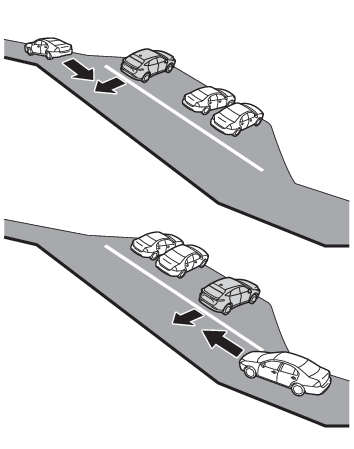
with the approaching vehicle.Examples of function operationThis function will operate in situations such as the following if a vehicle is detected
in the traveling direction of the vehicle.When reversing, a vehicle is approaching and the brake pedal is not depressed, or
is depressed lateTypes of sensorsHandling the radar sensorWarning:To ensure the Parking Support Brake (rear-crossing vehicles) can operate properlyObserve the following precautions regarding the rear radar sensors (Handling the radar sensor). Failure to do so may cause a sensor to not operate properly, and may cause an accident.Do not modify, disassemble or paint the sensors.Do not replace a rear radar sensor with a part other than a genuine part.Do not damage the rear radar sensors, and always keep the radar sensors and their
surrounding area on the bumper clean.If the area around a rear radar sensor is subjected to an impact, the system may not
operate properly due to a sensor malfunction. Have the vehicle inspected by your Toyota
dealer.Observe the rear radar sensor handling precautions. (BSM (Blind Spot Monitor))Note:The Parking Support Brake function (rear-crossing vehicles) will operate whenThe function will operate when the PKSB OFF indicator is not illuminated (Warning lights, Indicators) and all of the following conditions are met:Hybrid system output restriction controlThe Parking Support Brake is enabled.The vehicle speed is approximately 9 mph (15 km/h) or less.Vehicles are approaching from the right or left at the rear of the vehicle at a traveling
speed of less than approximately 5 mph (8 km/h)The shift lever is in R.The Parking Support Brake determines that a stronger than normal brake operation is
necessary to avoid a collision with an approaching vehicle.Brake controlHybrid system output restriction control is operatingThe Parking Support Brake determines that an emergency brake operation is necessary
to avoid a collision with an approaching vehicle.The Parking Support Brake function (rear-crossing vehicles) will stop operating whenThe function will stop operating if any of the following conditions are met:Hybrid system output restriction controlThe Parking Support Brake is disabled.The collision becomes avoidable with normal brake operation.A vehicle is no longer approaching from the right or left at the rear of the vehicle.Brake controlThe Parking Support Brake is disabled.Approximately 2 seconds have elapsed since the vehicle was stopped by brake control.The brake pedal is depressed after the vehicle is stopped by brake control.A vehicle is no longer approaching from the right or left at the rear of the vehicle.Detection area of the Parking Support Brake function (rear-crossing vehicles)The detection area of the Parking Support Brake function (rear-crossing vehicles)
differs from the detection area of the RCTA function (The RCTA function detection areas). Therefore, even if the RCTA function detects a vehicle and provides an alert, the
Parking Support Brake function (rear-crossing vehicles) may not start operating.Conditions under which the Parking Support Brake function (rear-crossing vehicles)
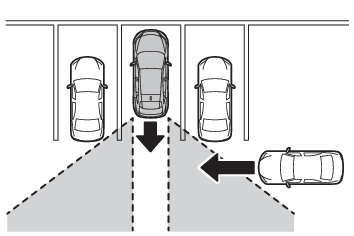
will not detect a vehicleThe Parking Support Brake function (rear-crossing vehicles) is not designed to detect
the following types of vehicles and/or objects:Vehicles approaching from directly behindVehicles backing up in a parking space next to your vehicleVehicles that the sensors cannot detect due to obstructionsVehicles which suddenly accelerate or decelerate near your vehicleGuardrails, walls, signs, parked vehicles and similar stationary objects*Small motorcycles, bicycles, pedestrians, etc.*Vehicles moving away from your vehicleVehicles approaching from the parking spaces next to your vehicle*Objects which are extremely close to a radar sensor*Vehicles which are approaching from the right or left at the rear of the vehicle at
a traveling speed of less than approximately 5 mph (8 km/h)Vehicles which are approaching from the right or left at the rear of the vehicle at
a traveling speed of more than approximately 15 mph (24 km/h)*Depending on the conditions, detection of a vehicle and/or object may occur.Situations in which the system may operate even though there is no possibility of
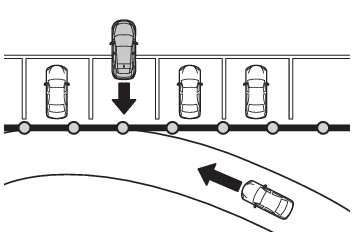
a collisionIn some situations such as the following, the Parking Support Brake function (rear-crossing
vehicles) may operate even though there is no possibility of a collision.When the parking space faces a street and vehicles are being driven on the streetWhen a detected vehicle turns while approaching the vehicleWhen a vehicle passes by the side of your vehicleWhen the distance between your vehicle and metal objects, such as a guardrail, wall,
sign, or parked vehicle, which may reflect electrical waves toward the rear of the
vehicle, is shortWhen there are spinning objects near your vehicle such as the fan of an air conditioning
unitWhen water is splashed or sprayed toward the rear bumper, such as from a sprinklerSituations in which the Parking Support Brake function (rear-crossing vehicles) may
not operate properlyIn some situations, such as the following, the radar sensors may not detect an object
and this function may not operate properlyStationary objectsWhen a sensor or the area around a sensor is extremely hot or coldIf the rear bumper is covered with ice, snow, dirt, etc.When it is raining heavily or water strikes the vehicleWhen the detection area of a radar sensor is obstructed by an adjacent vehicleIf the vehicle is significantly tiltedWhen equipment that may obstruct a sensor is installed, such as a towing eyelet, bumper
protector (an additional trim strip, etc.), bicycle carrier, or snow plowIf the suspension has been modified or tires of a size other than specified are installedIf the front of the vehicle is raised or lowered due to the carried loadIf a sticker or an electronic component, such as a backlit license plate (especially
fluorescent type), fog lights, fender pole or wireless antenna is installed near a
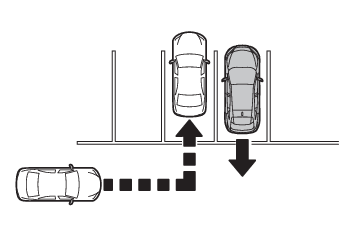
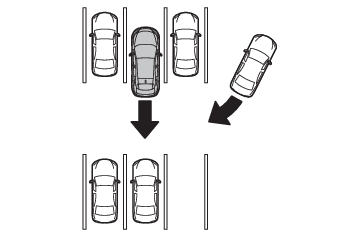
radar sensorIf the orientation of a radar sensor has been changedWhen multiple vehicles are approaching with only a small gap between each vehicleIf a vehicle is approaching the rear of your vehicle rapidlySituations in which the radar sensor may not detect a vehicleWhen a vehicle approaches from the right or left at the rear of the vehicle while
you are turning while backing upWhen turning while backing upWhen backing out of a shallow angle parking spotWhen backing up on a slope with a sharp change in gradeWhen a vehicle turns into the detection area