Traction motor (electric motor)Plug-in hybrid system
FeaturesPlug-in hybrid systemElectric motor (traction motor)Hybrid systemPlug-in hybrid system featuresThe plug-in hybrid system is a system excellent in both economical efficiency of electric
vehicles and practicality of Plug-in Hybrid Electric VehiclesEV driving can be performed using electricity charged from an external power source.*If the amount of electricity remaining in the hybrid battery (traction battery) becomes
low, the vehicle is automatically controlled in such a way that it can be driven as
a Plug-in Hybrid Electric Vehicle through the joint use of the gasoline engine.*The EV driving range will vary in accordance with conditions such as vehicle speed,
the amount of charge remaining in the hybrid battery (traction battery) and the usage
of the air conditioning system. The gasoline engine may also be used simultaneously
in accordance with driving conditions.Electric motor (traction motor)
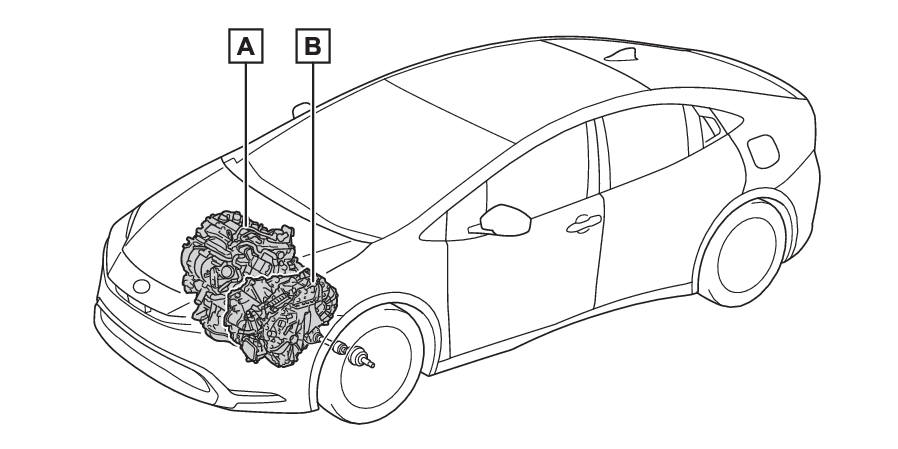
LocationSystem componentsThe illustration is an example for explanation and may differ from the actual item.Gasoline engineElectric motor (traction motor)Plug-in hybrid system
Plug-in hybrid system operation modePlug-in hybrid system operation modeThe plug-in hybrid system operates in the following modes.The meter display can be used to check which mode the plug-in hybrid system is currently
being driven in. (Warning lights and indicators)EV modePlug-in hybrid system
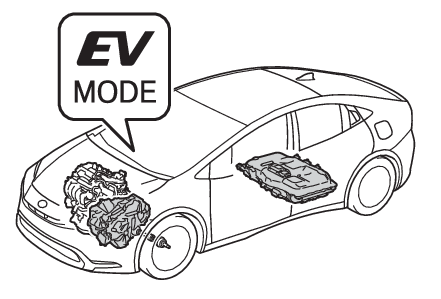
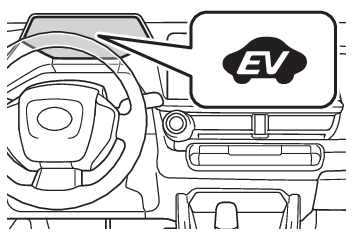
EV modeEV modeWhen a sufficient amount of electricity is remaining after charging*1, EV driving is performed using electricity stored in the hybrid battery (traction
battery).*2When in EV mode, the EV drive mode indicator illuminates.*1The amount of remaining charge can be checked on the SOC (State of Charge) gauge.
(Meter display)*2Depending on the situation, EV driving may be canceled and both gasoline engine and
electric motor are used. (Gasoline engine operation in EV mode or AUTO EV/HV mode)AUTO EV/HV modePlug-in hybrid system
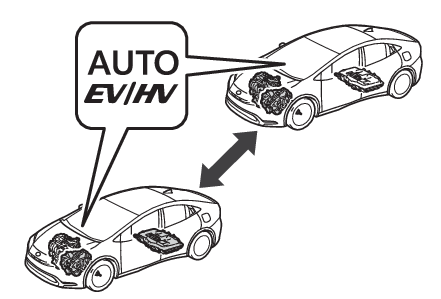
AUTO EV/HV modeAUTO EV/HV modeNormally, the electricity stored in the hybrid battery (traction battery) is used
for EV driving. However, when more power is required, such as for driving uphill or
accelerating suddenly, the gasoline engine starts and provides powerful acceleration
by strongly depressing the accelerator pedal.When the vehicle is in a condition where EV driving is possible, EV mode and AUTO
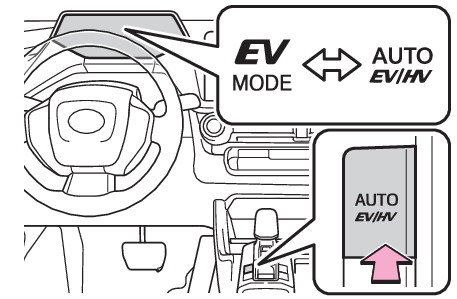
EV/HV mode can be switched by operating the switch. (Switching the plug-in hybrid system operation modesAUTO EV/HV mode switchEV/HV mode
selection switch)When in AUTO EV/HV mode, the AUTO EV/HV mode indicator illuminates.HV modePlug-in hybrid system
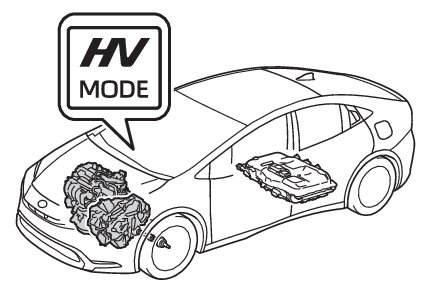
HV modeHV modeWhen in HV mode, the vehicle is driven using both the gasoline engine and electric
motor. (When in HV mode)If electricity needed for EV driving in EV mode or AUTO EV/HV mode is not remaining,
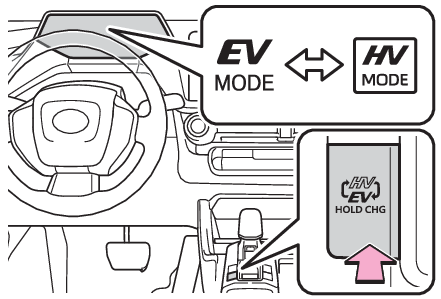
the operation mode will be automatically switched to HV mode.The operation mode can be switched to HV mode at any timing by operating the switch
to keep electricity for EV driving etc. (Switching the plug-in hybrid system operation modesAUTO EV/HV mode switchEV/HV mode
selection switch).* Switching to HV mode when driving on a highway or when driving uphill is recommended
in order to conserve battery power.When in HV mode, the HV drive mode indicator illuminates.*The EV driving range may reduce even after switching to HV mode.Plug-in hybrid system
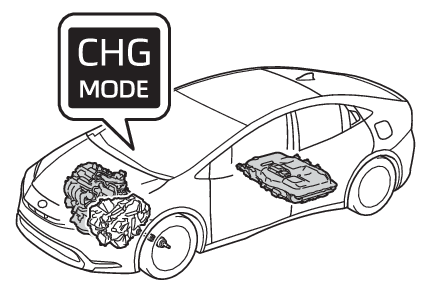
Hybrid battery (traction battery) charge modeHybrid battery (traction battery) charge mode (Switching to the hybrid battery (traction battery) charge mode)Electricity generated by the gasoline engine can be used to charge the hybrid battery
(traction battery) by switching to the hybrid battery (traction battery) charge mode
when electricity needed for EV driving is not remaining.*The system may not be able to switch to the hybrid battery (traction battery) charge
mode due to the state of the plug-in hybrid system. (Hybrid battery (traction battery) charge mode)Charging time differs depending on the driving state of the vehicle when driving in
hybrid battery (traction battery) charge mode.When in the hybrid battery (traction battery) charge mode, the hybrid battery charge
mode indicator illuminates.*When in the hybrid battery (traction battery) charge mode, the hybrid battery can
be charged while driving. However, the gasoline engine runs to charge the battery
and fuel consumption becomes higher compared with driving in HV mode.Switches
AUTO EV/HV mode switchSwitches
EV/HV mode selection switchPlug-in hybrid system
AUTO EV/HV mode switchPlug-in hybrid system
EV/HV mode selection switchEV/HV mode selection switchAUTO EV/HV mode switchSwitches
Plug-in hybrid system operation mode selection switchesPlug-in hybrid system operation mode selection switchesThe plug-in hybrid system operation modes can be switched using the switches.Switching the plug-in hybrid system operation modesPress the AUTO EV/HV mode switch or EV/HV mode selection switch to change modes as
the following table shows.When in EV mode, the EV drive mode indicator illuminates.When in AUTO EV/HV mode, the AUTO EV/HV mode indicator illuminates.When in HV mode, the HV drive mode indicator illuminates.AUTO EV/HV mode switch
*If there is not enough charge remaining in the hybrid battery (traction battery) to
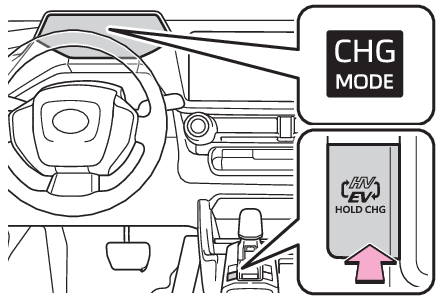
allow EV driving, EV mode will not be selectable.Hybrid battery (traction battery) charge modeSwitching to the hybrid battery (traction battery) charge modePress and hold the EV/HV mode selection switch.Take your hand off the switch once the hybrid battery charge mode indicator starts
to blink.The hybrid battery charge mode indicator illuminates when the switch to hybrid battery
(traction battery) charge mode is complete.When the hybrid battery (traction battery) is sufficient charged*, the hybrid battery (traction battery) charge mode is automatically canceled and
the operation mode will be switched to HV mode.The hybrid battery (traction battery) charge mode will be canceled by pressing AUTO
EV/HV mode switch or EV/HV mode selection switch.*The maximum charge amount in the hybrid battery (traction battery) charge mode is
approximately 80% of the sufficient charged capacity for the charging from an external
power source.Note:If the plug-in hybrid system operation mode cannot be changedIn the following situations, the plug-in hybrid system operation mode cannot be changed
even if the AUTO EV/HV mode switch or EV/HV mode selection switch is pressed. (In
this case, the warning message is displayed on the multi-information display when
the switch is pressed.)When electricity needed for EV driving is not remaining (when in EV mode or AUTO EV/HV
mode)When the hybrid battery (traction battery) is almost completely charged (hybrid battery
[traction battery] charge mode)When switching from EV mode to another mode using the switchWhen the power switch is turned off, operation mode switching is canceled and the
system returns to EV mode the next time the vehicle is started.**If there is not enough charge remaining in the hybrid battery (traction battery) to
allow EV driving, the system switches to HV mode.Hybrid battery (traction battery) charge modeThe following may occur to protect the system, etc.Cannot switch to hybrid battery (traction battery) charge mode or cannot cancel itGasoline engine does not start or stops even after switching to hybrid battery (traction
battery) charge modeIf a load to the system is large, such as when the power consumption of the air conditioning
system is large or when the temperature of the engine coolant is high, it may take
longer time than usual to charge using the hybrid battery (traction battery) charge
mode, or charging to the hybrid battery (traction battery) may not be performed.Warning:When using the hybrid battery (traction battery) charge modeObserve the following precautions when using the hybrid battery (traction battery)
charge mode while parking.Failure to do so may lead to death or serious health hazard, as the gasoline engine
operates when in the hybrid battery (traction battery) charge mode.Do not stop the vehicle near flammable materials.Do not use the hybrid battery (traction battery) charge mode in a closed area where
ventilation is insufficient, such as in a garage or area with snow buildup.Control when driving in each modeWhen in EV modeIn EV mode, EV driving (driving using only the electric motor)* is possible. However, depending on the situation, EV driving may be canceled and
both gasoline engine and electric motor are used (Gasoline engine operation in EV mode or AUTO EV/HV mode). Also, if a little electricity is remaining in the hybrid battery (traction battery),
HV mode is automatically selected. To drive in EV mode long, observe the followings.Avoid sudden acceleration and sudden deceleration, and be sure to drive smoothly.
If you repeatedly accelerate, the hybrid battery (traction battery) charge will deplete
quickly. Also, EV driving may be canceled by rapid acceleration or vehicle speed.Restrain your speed as much as possible. The distance that can be driven in EV mode
will reduce considerably at high speeds.*The EV driving range can be checked using the meter. (Meter display)When in AUTO EV/HV modeOnly the electric motor is used for EV driving* during normal driving, but when the accelerator pedal is strongly depressed, the
gasoline engine starts. (Gasoline engine operation in EV mode or AUTO EV/HV mode)Also, when the hybrid battery (traction battery) level is low, the mode switches to
HV mode automatically the same as in EV mode.AUTO EV/HV mode is suitable for driving conditions when more power is required, such
as for driving uphill or accelerating suddenly. However, because the gasoline engine
will start more easily, it is recommended to drive in EV mode usually.*The EV driving range can be checked using the meter. (Meter display)When in HV modeThe vehicle can be used in the same way as a standard Plug-in Hybrid Electric VehicleIn HV mode, controls are primarily carried out as follows in accordance with the driving
conditions.The gasoline engine stops* when the vehicle is stopped.During start off, the electric motor (traction motor) drives the vehicle.During normal driving, the gasoline engine and electric motor (traction motor) are
controlled effectively, and the vehicle is driven with optimum fuel efficiency. Also,
when necessary, the electric motor (traction motor) operates as an electrical generator
to charge the hybrid battery (traction battery).When the accelerator pedal is depressed heavily, drive force from both the gasoline
engine and the electric motor (traction motor) is used to accelerate.*When the hybrid battery (traction battery) requires charging or the engine is warming
up, etc., the gasoline engine will not automatically stop. (Conditions in which the gasoline engine may not stop)When braking (regenerative braking)The electric motor (traction motor) charges the hybrid battery (traction battery).The EV driving range can be extended by actively using this regenerative braking to
store electricity in the hybrid battery (traction battery).Moreover, as fuel consumption is also reduced when in HV mode, the regenerative braking
system can be used effectively.Note:Regenerative brakingHybrid system
Regenerative brakingBrake
Regenerative brakingRegenerative brakingIn the following situations, kinetic energy is converted to electric energy and deceleration
force can be obtained in conjunction with the recharging of the hybrid battery (traction
battery).The accelerator pedal is released while driving with the shift position in D or B.The brake pedal is depressed while driving with the shift position in D or B.The Regeneration Boost operates when the shift position is shifted to B. The regenerative
braking force can be changed when the Regeneration Boost is operating. (Regeneration Boost)EV driving rangeThe EV driving range is displayed on the meter. (Meter display)The EV driving range changes in accordance with the charge status of the hybrid battery
(traction battery), the speed of the vehicle, etc.Even if there is enough charge remaining in the hybrid battery (traction battery),
EV driving may be canceled and both gasoline engine and electric motor are used depending
on the situation. (Gasoline engine operation in EV mode or AUTO EV/HV mode)EV indicatorEV indicatorThe EV indicator comes on when the vehicle is driven using only the electric motor
(traction motor) or the gasoline engine is stopped.The on/off operation of the EV indicator can be changed. (Settings display)After EV mode has switched to HV mode due to low hybrid battery (traction battery)
chargeIf the hybrid battery (traction battery) is regenerated by driving continuously down
a long slope, the EV driving range etc. will be displayed on the meter and EV mode
will be automatically switched to.If EV mode is not switched to even though EV driving range is being displayed, EV
mode can be switched to by pressing the EV/HV mode selection switch.Gasoline engine operation in EV mode or AUTO EV/HV modeEven if there is a sufficient amount of electricity remaining in the hybrid battery
(traction battery) and EV driving range (Meter display) is being displayed on the meter, EV driving (driving using only the electric motor)
may be canceled and both gasoline engine and electric motor are used depending on
the situation (EV driving will be returned to automatically after EV driving becomes
possible again).EV driving may be canceled automatically in the following circumstances*1:When vehicle speed is more than approximately 84 mph (135 km/h).When power is needed temporarily, for example when the accelerator pedal is depressed
firmly or when accelerating suddenly.*2When the temperature of the hybrid system is high. The vehicle has been left in the
sun, driven on a hill, driven at high speeds, etc.When the temperature of the hybrid system is low.When the heater is switched on when the outside temperature is below about 14°F (-10°C).When the windshield defogger switch is pressed. (Air conditioning controls)When the system determines that the gasoline engine needs to be started.*1The gasoline engine may also operate in circumstances other than those listed above,
depending on conditions.*2When driving in AUTO EV/HV mode. Even in EV mode, the gasoline engine may start, depending
on the condition of the hybrid battery (traction battery).If “
Engine Started to Protect System EV driving unavailable” is displayed on the multi-information displayEV driving may be canceled in order to protect the hybrid system, etc.In this case,
perform driving with the gasoline engine until EV driving will be returned to automatically.
Depending on the conditions, driving that combines the use of the gasoline engine
may continue for a short while. However, this is not a malfunction.Conditions in which the gasoline engine may not stopThe gasoline engine starts and stops automatically. However, it may not stop automatically
in the following conditions*:During gasoline engine warm-upDuring hybrid battery (traction battery) chargingWhen the temperature of the hybrid battery (traction battery) is high or lowWhen the windshield defogger switch is pressed. (Air conditioning controls)*Depending on the circumstances, the gasoline engine may also not stop automatically
in situations other than those above.Sounds and vibrations specific to a Plug-in Hybrid Electric VehicleBecause there is no engine sound or vibration, it is easy to mistake the Plug-in Hybrid
Electric Vehicle for being off when it is actually still running, as indicated by
the “
READY” indicator being illuminated. For safety, make sure to always shift the shift position
to P and apply the parking brake when parked.The following sounds or vibrations may occur when the hybrid system is operating and
are not a malfunction.Motor sounds may be heard from the engine compartment.Sounds may be heard from the hybrid battery (traction battery) when the hybrid system
starts or stops.Relay operating sounds such as a snap or soft clank will be emitted from the hybrid
battery (traction battery), under the rear seats or under the floor, when the hybrid
system is started or stopped.Sounds from the hybrid system may be heard when the back door is open.Sounds may be heard from the transmission when the gasoline engine starts or stops,
when driving at low speeds, or during idling.Engine sounds may be heard when accelerating sharply.Sounds may be heard due to regenerative braking when the brake pedal is depressed
or as the accelerator pedal is released.Vibration may be felt when the gasoline engine starts or stops.Sounds may be heard from near the hybrid battery (traction battery) in accordance
with the operation of the air conditioning system or battery cooler. (“Battery Cooler”)Maintenance, repair, recycling, and disposalContact your Toyota dealer regarding maintenance, repair, recycling and disposal.
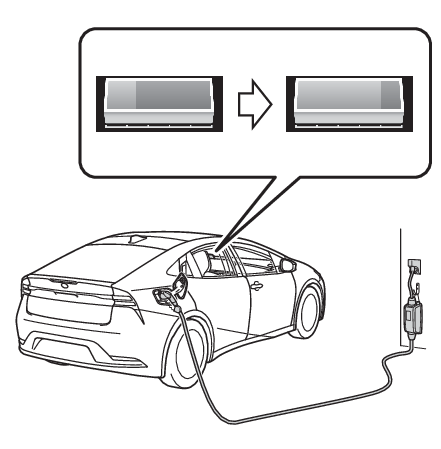
Do not dispose of the vehicle yourself.Charging (Charging equipment)In order to make EV mode or AUTO EV/HV mode available, charge the hybrid battery (traction
battery) from an external power source before using the vehicle.Even if charging the hybrid battery (traction battery) has not been completed, the
vehicle can be driven. However, if there is not enough charge remaining, it is possible
that the vehicle cannot be driven in EV mode or AUTO EV/HV mode or the EV driving
range will become shorter.Note:Refilling fuelPlug-in Hybrid Electric Vehicles can be driven using electricity charged from an external
power source. However, as the gasoline engine is used depending on the situation (Gasoline engine operation in EV mode or AUTO EV/HV mode) even if in EV mode or AUTO EV/HV mode, and the gasoline engine is provided on board
as a power source for driving in HV mode, it is needed to refueling the vehicle.Check the fuel amount and refill immediately when the fuel level becomes low. (Opening the fuel tank cap)If the vehicle is not used for a long timeThe 12-volt battery may discharge. In this event, charge the 12-volt battery. (If the 12-volt battery is discharged - If the 12-volt battery is discharged) In order to prevent the hybrid battery (traction battery) from becoming extremely
low in charge, charge the hybrid battery (traction battery) from external power source
or start the hybrid system at least once every 2 or 3 months, and turn the power switch
off after the gasoline engine has stopped automatically. (If the gasoline engine does
not start up even after approximately 10 seconds have passed since the “
READY” indicator came on, the power switch can be turned to off without any further action.)
When the 12-volt battery is discharged, refer to If the 12-volt battery is discharged - If the 12-volt battery is discharged, “If the 12-volt battery is discharged” and perform the correction procedure.When the vehicle is left with the AC charging cable connected, the electricity consumption
amount of the 12-volt battery increases due to controls, such as the system checking,
operating. When the AC charging cable is not needed, remove it from the vehicle.Hybrid system
Acoustic Vehicle Alerting SystemAcoustic Vehicle Alerting SystemAcoustic Vehicle Alerting SystemWhen driving with the gasoline engine stopped, a sound, which changes in accordance
with the driving speed, will be played in order to warn people nearby of the vehicle’s
approach. The sound will stop when the vehicle speed exceeds approximately 22 mph
(35 km/h).Note:Acoustic Vehicle Alerting SystemIn the following cases, the Acoustic Vehicle Alerting System may be difficult for
surrounding people to hear.In very noisy areasIn the wind or the rainAlso, as the Acoustic Vehicle Alerting System is installed on the front of the vehicle,
it may be more difficult to hear from the rear of the vehicle compared to the front.When “
Acoustic Vehicle Alerting System Malfunction Visit your Dealer” is displayed on the multi-information displayThe Acoustic Vehicle Alerting System may be malfunctioning. Have the vehicle inspected
by your Toyota dealer immediately.Predictive efficient drivePredictive efficient drive (vehicles with navigation system)**This function can only be used in the mainland U.S.A. It cannot be used in other states
and territories, including Alaska and Hawaii.This system operates based on the driving situation and traffic information to enhance
fuel economy.For details about Predictive efficient drive, refer to “
MULTIMEDIA OWNER’S MANUAL”.Predictive deceleration supportWhen the vehicle approaches to predictive deceleration support points registered in
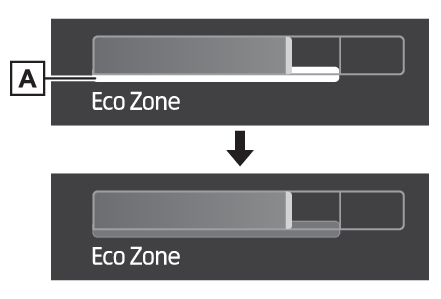
the navigation system, the reference operation range (
) of the ECO Accelerator Guidance (ECO Accelerator Guidance/“Eco Score”) on the multi-information display will be turned off to encourage the driver to reduce
excessive acceleration.The engine braking force will be increased according to the driving conditions to
more efficiently charge the hybrid battery (traction battery) after the accelerator
pedal is released.