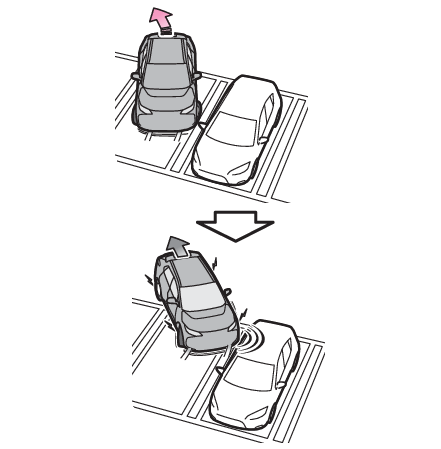
PKSB (Parking Support Brake)
Static Objects Front and Rear of the vehiclePKSB (Parking Support Brake)
Static objects around of the vehicleParking Support Brake function (static objects front and rear of the vehicle/static
objects around the vehicle)**If equippedIf the sensors detect a static object, such as a wall, in the traveling direction
of the vehicle and the system determines that a collision may occur due to the vehicle
suddenly moving forward due to an accidental accelerator pedal operation, the vehicle
moving the unintended direction due to the wrong shift position being selected, or
while parking or traveling at low speeds, the system will operate to lessen the impact
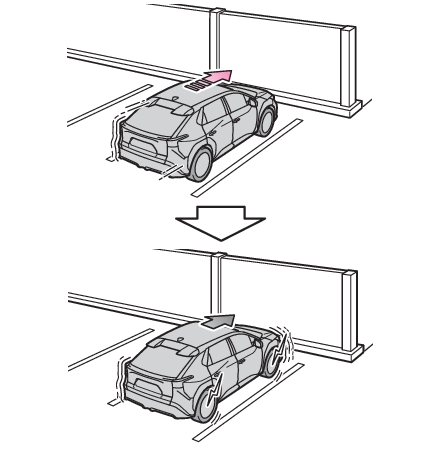
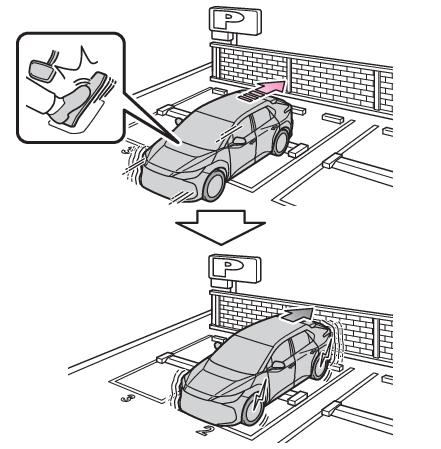
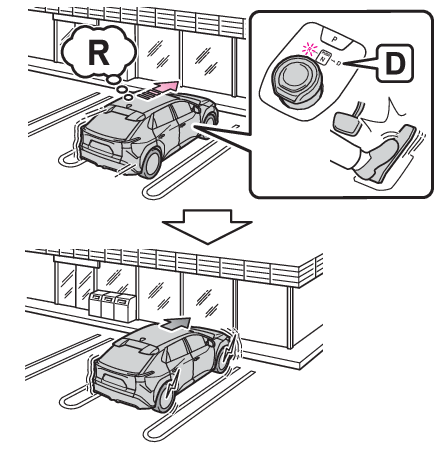
with the detected static object and reduce the resulting damage.Examples the of function operation (static objects front and rear of the vehicle)This function will operate in situations such as the following if an object is detected
in the traveling direction of the vehicle.When traveling at a low speed and the brake pedal is not depressed, or is depressed
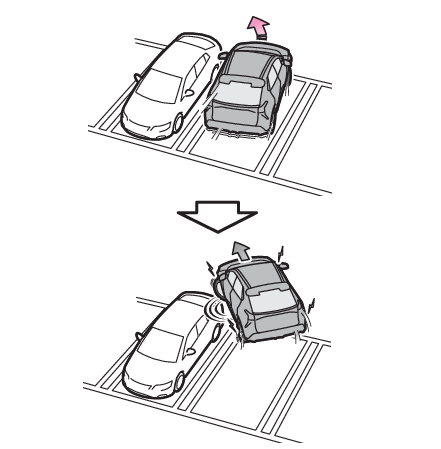
lateWhen the accelerator pedal is depressed excessivelyWhen the vehicle moves forward due to the incorrect shift position being selectedExamples of function operation (static objects around the vehicle) (Vehicles with
Advanced Park)The system will operate in the following situations when a stationary object is detected
in the surrounding area.When moving forward and a collision with a stationary object on the inner side of
a turn is likelyWhen reversing and a collision with a stationary object on the outer side of a turn
is likelyTypes of sensorsType of sensorsWarning:To ensure the system can operate properlyTo ensure the system can operate properlyIf the Parking Support Brake function operates unnecessarily, such as at a railroad
crossingIf the Parking Support Brake has operatedNotes when washing the vehicleNotes when washing the vehicleNote:The Parking Support Brake function (static objects front and rear of the vehicle)
will operate whenThe function will operate when the driving assist information indicator is not illuminated
(Warning lights, Indicators) and all of the following conditions are met:EV system output restriction controlThe Parking Support Brake is enabled.The vehicle speed is approximately 9 mph (15 km/h) or less.There is a static object in the traveling direction of the vehicle and approximately
6 to 13 ft. (2 to 4 m) away.The Parking Support Brake determines that a stronger-than-normal brake operation is
necessary to avoid a collision.Brake controlEV system output restriction control is operating.The Parking Support Brake determines that an immediate brake operation is necessary
to avoid a collision.The Parking Support Brake function (static objects around the vehicle) will operating
when (Vehicles with Advanced Park)This function is operable when any of the following conditions is met in addition
to the operating conditions for static objects in front and rear of the vehicle.After the EV system has been started, the vehicle has moved approximately 23.0 ft.
(7 m) or lessThe R shift position is selectedAfter the shift position has been changed from R to D, the vehicle has moved approximately
23.0 ft. (7 m) or lessThe Parking Support Brake function (static objects front and rear of the vehicle/static
objects around the vehicle) will stop operating whenThe function will stop operating if any of the following conditions are met:EV system output restriction controlThe Parking Support Brake is disabled.The system determines that the collision has become avoidable with normal brake operation.The static object is no longer approximately 6 to 13 ft. (2 to 4 m) away from the
vehicle or in the traveling direction of the vehicle.Brake controlThe Parking Support Brake is disabled.Approximately 2 seconds have elapsed since the vehicle was stopped by brake control.The brake pedal is depressed after the vehicle is stopped by brake control.The static object is no longer approximately 6 to 13 ft. (2 to 4 m) away from the
vehicle or in the traveling direction of the vehicle.Detection range of the Parking Support Brake function (static objects front and rear
of the vehicle/static objects around the vehicle)The detection range of the Parking Support Brake function (static objects front and
rear of the vehicle/static objects around the vehicle) differs from the detection
range of the intuitive parking assist (Sensor detection display, object distance). Therefore, even if the intuitive parking assist detects an object and provides
a warning, the Parking Support Brake function (static objects front and rear of the
vehicle/static objects around the vehicle) may not start operating.Situations in which the system may not operate properlySituations in which the system may not operate properlySituations in which the system may operate even if there is no possibility of a collisionSituations in which the system may operate even if there is no possibility of a collisionSituations in which the system may operate even though there is no possibility of
a collision (static objects around the vehicle) (vehicles with Advanced Park)In addition to the situations in which static objects in front and rear of the vehicle
(The Parking Support Brake function (static objects front and rear of the vehicle)
will operate when) may not be detected, objects may not be detected by the sensors in the following
situations:When moving sideways, such as when parallel parking (Advanced Park Parallel parking function)Detection of objects along the sides of the vehicle (static objects around the vehicle)
(vehicles with Advanced Park)Objects along the sides of the vehicle are not instantaneously detected. The location
of objects in relation to the vehicle is estimated after they are first detected by
the front or rear side sensors, or side cameras. Therefore, after the power switch
is changed to ON, even if an object is along the side of the vehicle, it may not be
detected until the vehicle has been driven a small amount and the side sensors or
side cameras completely scan the areas along the sides of the vehicle.If a vehicle, person, animal, etc., is detected by a side sensors or side cameras,
but then leaves the detection area of the side sensors or side cameras, the system
will assume the object has not moved.