Electric Vehicle system featuresEV system
FeaturesEV systemElectric Vehicle system featuresBattery electric vehicles are considerably different from conventional vehicles.They use electricity charged in a traction battery, to drive the electric motor. Since
battery electric vehicles are driven using electricity, they do not emit any emissions
such as CO2 (Carbon Dioxide) and NOx (Nitrogen Oxides). Battery electric vehicles are environmentally
friendly vehicles.Battery (traction battery)
LocationBattery (traction battery)Electric motor (traction motor)
LocationTraction battery
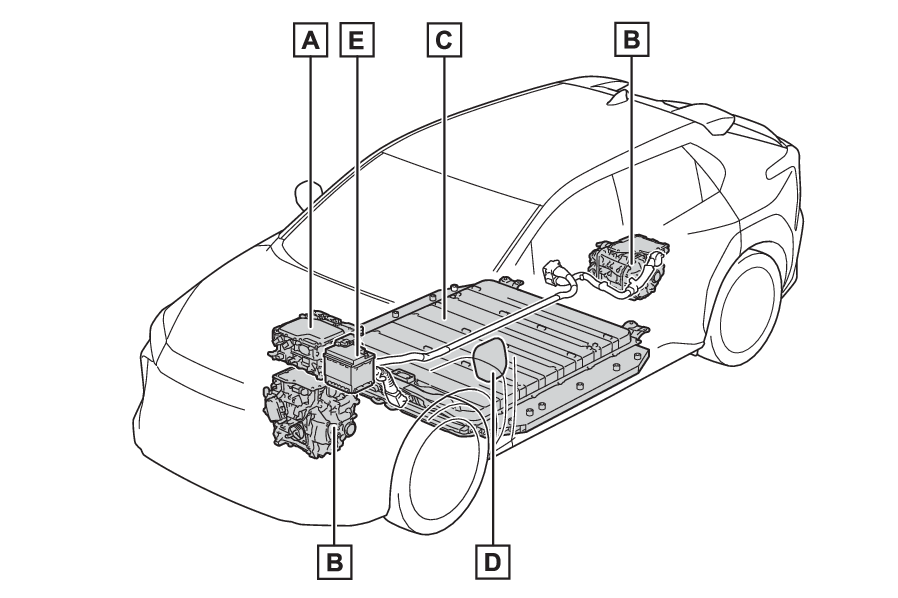
LocationTraction batterySystem componentsThe illustration is an example for explanation and may differ from the actual item.ESU: Electricity Supply Unit (built in onboard traction battery charger/DC-DC converter)Electric motor (traction motor)/Inverter (front/rear*)Traction batteryProvides electricity to the electric motor.Charging port12-volt batteryProvides electricity to various vehicle systems such as the SRS airbags, headlights,
wipers, etc.*AWD models onlyBrake
Regenerative brakingEV system
Regenerative brakingRegenerative brakingWhen braking (regenerative braking)The electric motor (traction motor) charges the traction battery.The driving range can be extended by actively using this regenerative braking to store
electricity in the traction battery.ChargingThe battery electric vehicle is driven using electricity, which is received from an
external power source and stored in the traction battery. Not only public charging
stations, but also household outlets can be used for charging. Procedures are different
from refueling a conventional vehicle. Therefore, make sure to read the following
thoroughly.Charging equipment (Charging equipment)AC charging cable (AC charging cable*)Power sources that can be used (Things to know before charging)Things to know before charging (Things to know before charging)How to charge your vehicle (How to use AC charging, How to use DC charging)When charging cannot be performed normally (When charging cannot be carried out)Note:Regenerative brakingIn the following situations, kinetic energy is converted to electric energy and deceleration
force can be obtained in conjunction with the recharging of the traction battery.The accelerator pedal is released while driving with the shift position in D.The brake pedal is depressed while driving with the shift position in D.Charging the 12-volt batteryThe 12-volt battery is charged from the traction battery when the EV system is operated
or while the traction battery is being charged.If the vehicle has not been used for a long time, the 12-volt battery may become low
due to self-discharge. If this occurs, follow the correct procedures. (If the 12-volt battery is discharged)When not using the vehicle for an extended period of timeWhen the vehicle will not be used for an extended period of time, charge the traction
battery once a month. This protects the traction battery from extreme voltage decline
due to self discharging.When the vehicle will not be used for an extended period of time, the 12-volt battery
will be charged from the traction battery to reduce the risk of the 12-volt battery
discharged. In this case, the cooling fan may operate, however it is not a malfunction.To prevent the 12-volt battery from being discharged, do not leave the charging port
lid open or the charging cable connected to the vehicle.Charging the traction batteryBe sure to maintain the traction battery charge level suitable for your driving needs.If the traction battery fully discharges, the vehicle cannot be driven at all. When
the battery becomes low, charge it as soon as possible.If the traction battery becomes lowIf the traction battery becomes low, the traction battery charge warning light comes
on or flashes and a message will be displayed on the multi-information display. (Traction battery charge warning light)If the traction battery is completely discharged, the EV system cannot be started
and driving will not be possible. When the traction battery becomes low, charge it
as soon as possible.Sounds and vibrations specific to an battery electric vehicleBecause there is no engine sound or vibration, it is easy to mistake the battery electric
vehicle for being off when it is actually still running, as indicated by the “
READY” indicator being illuminated. For safety, make sure to always shift the shift position
to P and apply the parking brake when parked.Before and after the EV system is started, the following sounds and vibrations may
occur. However, these sounds and/or vibrations are not signs of malfunctions:The brake system operation sound may be heard from the front of the vehicle when the
driver’s door is opened.Motor sounds may be heard from the motor compartment or luggage compartment.Electrical relay sounds may be heard from the motor compartment when the EV system
starts or stops.Relay operating sounds such as a snap or soft clank will be emitted from the traction
battery in the following situations:When the EV system is started or stoppedWhen charging starts or completesWhen the vehicle is driven the first time after the traction battery has been charged
using DC chargingSounds may be heard due to regenerative braking when the brake pedal is depressed
or as the accelerator pedal is released.Cooling fan operating sounds from the radiator.The operation sound of the air conditioning system (air conditioning compressor, blower
motor).Maintenance, repair, recycling, and disposalContact your Toyota dealer regarding maintenance, repair, recycling and disposal.
Do not dispose of the vehicle yourself.EV system
Acoustic Vehicle Alerting SystemAcoustic Vehicle Alerting SystemAcoustic Vehicle Alerting SystemA sound which changes in accordance with the driving speed, will be played in order
to warn people nearby of the vehicle’s approach. This sound may be heard inside the
vehicle. The sound will stop when the vehicle speed exceeds approximately 23 mph (37
km/h).Note:Acoustic Vehicle Alerting SystemIn the following cases, the Acoustic Vehicle Alerting System may be difficult for
surrounding people to hear.In very noisy areasIn the wind or the rainAlso, as the Acoustic Vehicle Alerting System is installed on the front of the vehicle,
it may be more difficult to hear from the rear of the vehicle compared to the front.