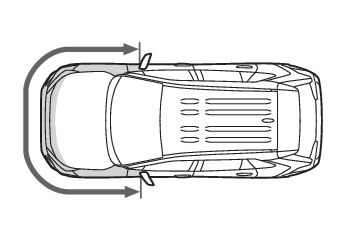
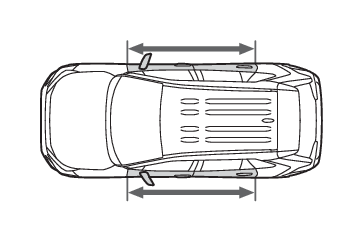
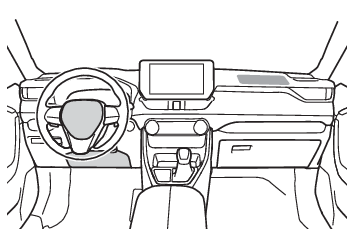
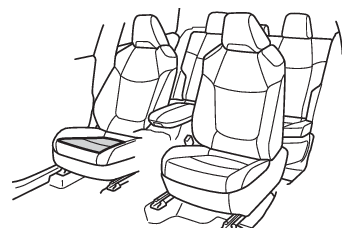
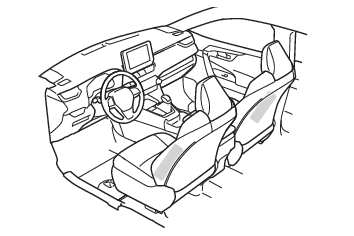
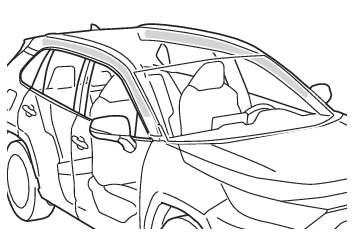
Side airbagsKnee airbagsCurtain shield airbagsAirbagsAirbags
SRS airbagsAirbags
Seat cushion airbagAirbags
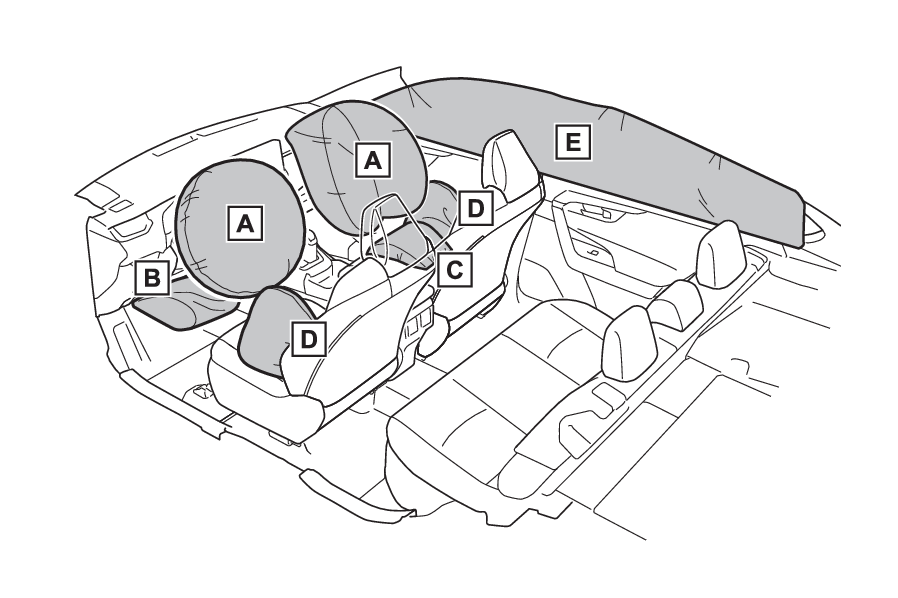
Locations of airbagsSRS airbagsThe SRS airbags inflate when the vehicle is subjected to certain types of severe impacts
that may cause significant injury to the occupants. They work together with the seat
belts to help reduce the risk of death or serious injury.SRS airbag systemLocation of the SRS airbagsSRS front airbagsSRS driver airbag/front passenger airbagCan help protect the head and chest of the driver and front passenger from impact
with interior componentsSRS knee airbagCan help provide driver protectionSRS seat cushion airbagCan help restrain the front passengerSRS side and curtain shield airbagsSRS side airbagsCan help protect the torso of the front seat occupantsSRS curtain shield airbagsCan help protect primarily the head of occupants in the outboard seatsCan help prevent the occupants from being thrown from the vehicle in the event of
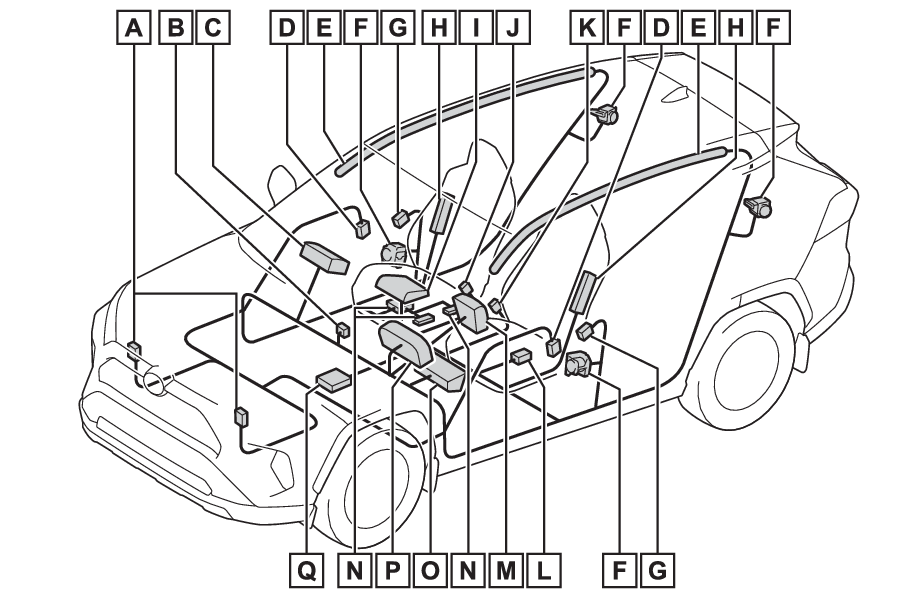
vehicle rolloverSRS airbag system componentsFront impact sensors“
AIR BAG ON” and “
AIR BAG OFF” indicator lightsFront passenger airbagSide impact sensors (front door)Curtain shield airbagsSeat belt pretensioners and force limitersSide impact sensors (front)Side airbagsSeat cushion airbagFront passenger’s seat belt buckle switchDriver’s seat belt buckle switchDriver’s seat position sensorDriver airbagFront passenger occupant classification system (ECU and sensors)Knee airbagSRS warning lightAirbag sensor assemblyYour vehicle is equipped with ADVANCED AIRBAGS designed based on the US motor vehicle
safety standards (FMVSS208). The airbag sensor assembly (ECU) controls airbag deployment
based on information obtained from the sensors etc. shown in the system components
diagram above. This information includes crash severity and occupant information.
As the airbags deploy, a chemical reaction in the inflators quickly fills the airbags
with non-toxic gas to help restrain the motion of the occupants.Note:If the SRS airbags deploy (inflate)Slight abrasions, burns, bruising etc., may be sustained from SRS airbags, due to
the extremely high speed deployment (inflation) by hot gases.A loud noise and white powder will be emitted.Parts of the airbag module (steering wheel hub, airbag cover and inflator) as well
as the front seats, parts of the front and rear pillars, and roof side rails, may
be hot for several minutes. The airbag itself may also be hot.The windshield may crack.The brakes and stop lights will be controlled automatically. (The Secondary Collision Brake)The interior lights will turn on automatically. (The interior lights may turn on automatically when)The emergency flashers will turn on automatically. (Emergency flashers)Fuel supply to the engine will be stopped. (Fuel pump shut off system)For Safety Connect subscribers, if any of the following situations occur, the system
is designed to send an emergency call to the response center, notifying them of the
vehicle’s location (without needing to push the “
SOS” button) and an agent will attempt to speak with the occupants to ascertain the level
of emergency and assistance required. If the occupants are unable to communicate,
the agent automatically treats the call as an emergency and helps to dispatch the
necessary emergency services. (Safety Connect*)An SRS airbag is deployed.A seat belt pretensioner is activated.The vehicle is involved in a severe rear-end collision.Airbags
Airbag operating conditionsSRS airbag deployment conditions (SRS front airbags)The SRS front airbags will deploy in the event of an impact that exceeds the set threshold
level (the level of force corresponding to an approximately 12 - 18 mph [20 - 30 km/h]
frontal collision with a fixed wall that does not move or deform).However, this threshold velocity will be considerably higher in the following situations:If the vehicle strikes an object, such as a parked vehicle or sign pole, which can
move or deform on impactIf the vehicle is involved in an underride collision, such as a collision in which
the front of the vehicle underrides, or goes under, the bed of a truckDepending on the type of collision, it is possible that only the seat belt pretensioners
will activate.The SRS front airbags for the front passenger will not activate if there is no passenger
sitting in the front passenger seat. However, the SRS front airbags for the front
passenger may deploy if luggage is put in the seat, even if the seat is unoccupied.The SRS seat cushion airbag on the front passenger seat will not operate if the occupant
is not wearing a seat belt.Airbags
Side and curtain shield airbags operating conditionsAirbags
Side airbag operating conditionsAirbags
Curtain shield airbag operating conditionsSRS airbag deployment conditions (SRS side and curtain shield airbags)The SRS side and curtain shield airbags will deploy in the event of an impact that
exceeds the set threshold level (the level of force corresponding to the impact force
produced by an approximately 3300 lb. [1500 kg] vehicle colliding with the vehicle
cabin from a direction perpendicular to the vehicle orientation at an approximate
speed of 12 - 18 mph [20 - 30 km/h]).Both SRS curtain shield airbags will deploy in the event of a side collision on either
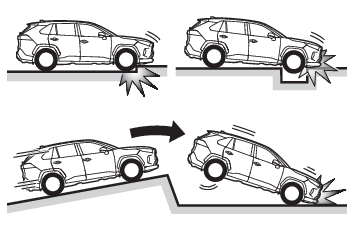
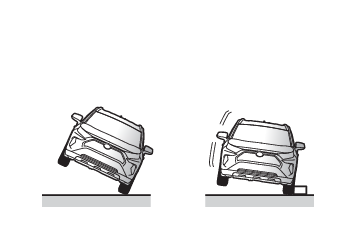
side.Both SRS curtain shield airbags will deploy in the event of vehicle rollover.Both SRS curtain shield airbags may also deploy in the event of a severe frontal collision.Conditions under which the SRS airbags may deploy (inflate), other than a collisionThe SRS front airbags and SRS curtain shield airbags may also deploy if a serious
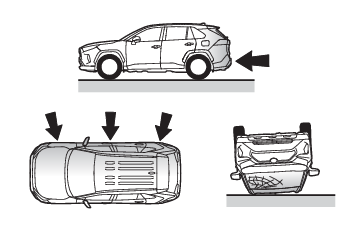
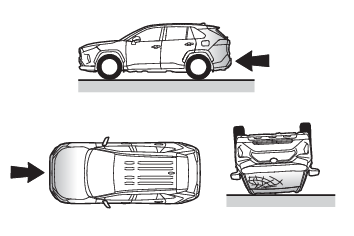
impact occurs to the underside of your vehicle. Some examples are shown in the illustration.Hitting a curb, edge of pavement or hard surfaceFalling into or jumping over a deep holeLanding hard or fallingThe SRS curtain shield airbags may also deploy under the situations shown in the illustration.The angle of vehicle tip-up is marginal.The vehicle skids and hits a curb stone.Types of collisions that may not deploy the SRS airbags (SRS front airbags)The SRS front airbags do not generally inflate if the vehicle is involved in a side
or rear collision, if it rolls over, or if it is involved in a low-speed frontal collision.
But, whenever a collision of any type causes sufficient forward deceleration of the
vehicle, deployment of the SRS front airbags may occur.Collision from the sideCollision from the rearVehicle rolloverTypes of collisions that may not deploy the SRS airbags (SRS side and curtain shield
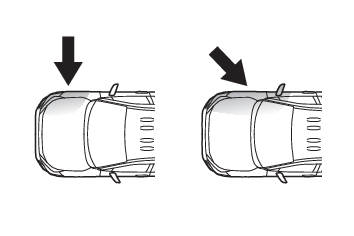
airbags)The SRS side and curtain shield airbags may not activate if the vehicle is subjected
to a collision from the side at certain angles, or a collision to the side of the
vehicle body other than the passenger compartment.Collision from the side to the vehicle body other than the passenger compartmentCollision from the side at an angleThe SRS side airbags do not generally inflate if the vehicle is involved in a frontal
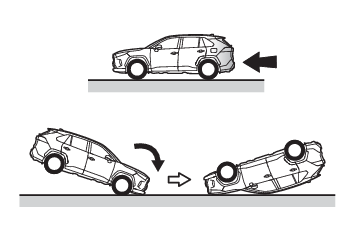
or rear collision, if it rolls over, or if it is involved in a low-speed side collision.Collision from the frontCollision from the rearVehicle rolloverThe SRS curtain shield airbags do not generally inflate if the vehicle is involved
in a rear collision, if it pitches end over end, or if it is involved in a low-speed
side or low-speed frontal collision.Collision from the rearPitching end over endWhen to contact your Toyota dealerIn the following cases, the vehicle will require inspection and/or repair. Contact
your Toyota dealer as soon as possible.Any of the SRS airbags have been inflated.The front of the vehicle is damaged or deformed, or was involved in an accident that
was not severe enough to cause the SRS front airbags to inflate.A portion of a door or its surrounding area is damaged, deformed or has had a hole
made in it, or the vehicle was involved in an accident that was not severe enough
to cause the SRS side and curtain shield airbags to inflate.The pad section of the steering wheel, dashboard near the front passenger airbag or
lower portion of the instrument panel is scratched, cracked, or otherwise damaged.The seat cushion surface is scratched, cracked, or otherwise damaged.The surface of the seats with the SRS side airbag is scratched, cracked, or otherwise
damaged.The portion of the front pillars, rear pillars or roof side rail garnishes (padding)
containing the SRS curtain shield airbags inside is scratched, cracked, or otherwise
damaged.Warning:Child safety
Airbag precautionsAirbags
Side and curtain shield airbags precautionsAirbags
Side airbag precautionsAirbags
General airbag precautionsAirbags
Curtain shield airbag precautionsAirbags
Airbag precautions for your childSRS airbag precautionsObserve the following precautions regarding the SRS airbags.Failure to do so may cause
death or serious injury.The driver and all passengers in the vehicle must wear their seat belts properly.The
SRS airbags are supplemental devices to be used with the seat belts.The SRS driver airbag deploys with considerable force, and can cause death or serious
injury especially if the driver is very close to the airbag. The National Highway
Traffic Safety Administration (NHTSA) advises:Since the risk zone for the driver’s airbag is the first 2 - 3 in. (50 - 75 mm) of
inflation, placing yourself 10 in. (250 mm) from your driver airbag provides you with
a clear margin of safety. This distance is measured from the center of the steering
wheel to your breastbone. If you sit less than 10 in. (250 mm) away now, you can change
your driving position in several ways:Move your seat to the rear as far as you can while still reaching the pedals comfortably.Slightly recline the back of the seat. Although vehicle designs vary, many drivers
can achieve the 10 in. (250 mm) distance, even with the driver seat all the way forward,
simply by reclining the back of the seat somewhat. If reclining the back of your seat
makes it hard to see the road, raise yourself by using a firm, non-slippery cushion,
or raise the seat if your vehicle has that feature.If your steering wheel is adjustable, tilt it downward. This points the airbag toward
your chest instead of your head and neck.The seat should be adjusted as recommended by NHTSA above, while still maintaining
control of the foot pedals, steering wheel, and your view of the instrument panel
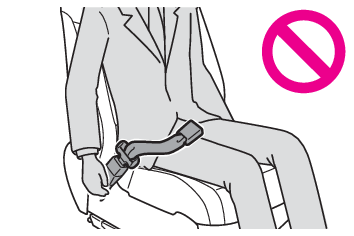
controls.If the seat belt extender has been connected to the front seat belt buckles but the
seat belt extender has not also been fastened to the latch plate of the seat belt,
the SRS front airbags will judge that the driver and front passenger are wearing the
seat belt even though the seat belt has not been connected. In this case, the SRS
front airbags may not activate correctly in a collision, resulting in death or serious
injury in the event of a collision. Be sure to wear the seat belt with the seat belt
extender.The SRS front passenger airbag also deploys with considerable force, and can cause
death or serious injury especially if the front passenger is very close to the airbag.
The front passenger seat should be as far from the airbag as possible with the seatback
adjusted, so the front passenger sits upright.Improperly seated and/or restrained infants and children can be killed or seriously
injured by a deploying airbag. An infant or child who is too small to use a seat belt
should be properly secured using a child restraint system. Toyota strongly recommends
that all infants and children be placed in the rear seats of the vehicle and properly
restrained. The rear seats are safer for infants and children than the front passenger
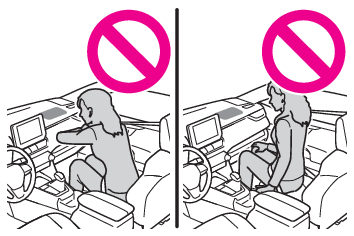
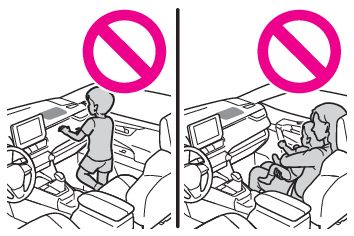
seat. (Child restraint systems)Do not sit on the edge of the seat or lean against the dashboard.Do not allow a child to stand in front of the SRS front passenger airbag unit or sit
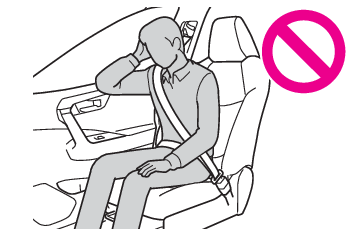
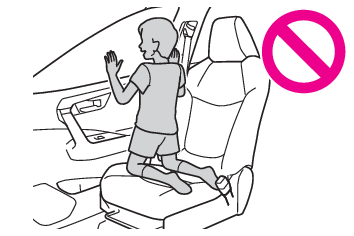
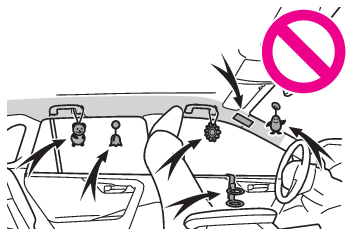
on the knees of a front passenger.Do not allow the front seat occupants to hold items on their knees.Do not lean against the door, the roof side rail or the front, side and rear pillars.Do not allow anyone to kneel on the passenger seat toward the door or put their head
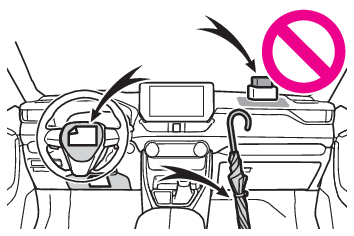
or hands outside the vehicle.Do not attach anything to or lean anything against areas such as the dashboard, steering
wheel pad and lower portion of the instrument panel.These items can become projectiles
when the SRS driver, front passenger and knee airbags deploy.Do not attach anything to areas such as a door, windshield, side window, front or
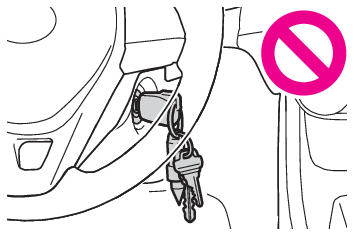
rear pillar, roof side rail and assist grip.Vehicles without smart key system: Do not attach any heavy, sharp or hard objects
such as keys and accessories to the key. The objects may restrict the SRS knee airbag
inflation or be thrust into the driver’s seat area by the force of the deploying airbag,
thus causing a danger.Do not hang coat hangers or other hard objects on the coat hooks. All of these items
could become projectiles and may cause death or serious injury, should the SRS curtain
shield airbags deploy.If a vinyl cover is put on the area where the SRS knee airbag will deploy, be sure
to remove it.Do not use seat accessories which cover the parts where the SRS side airbags and SRS
seat cushion airbag inflate as they may interfere with inflation of the SRS airbags.
Such accessories may prevent the SRS side airbags and SRS seat cushion airbag from
activating correctly, disable the system or cause the SRS side airbags and SRS seat
cushion airbag to inflate accidentally, resulting in death or serious injury.Do not strike or apply significant levels of force to the area of the SRS airbag components
or the front doors.Doing so can cause the SRS airbags to malfunction.Do not touch any of the component parts immediately after the SRS airbags have deployed
(inflated) as they may be hot.If breathing becomes difficult after the SRS airbags have deployed, open a door or
window to allow fresh air in, or leave the vehicle if it is safe to do so. Wash off
any residue as soon as possible to prevent skin irritation.If the areas where the SRS airbags are stored, such as the steering wheel pad and
front and rear pillar garnishes, are damaged or cracked, have them replaced by your
Toyota dealer.Do not place anything, such as a cushion, on the front passenger’s seat. Doing so
will disperse the passenger’s weight, which prevents the sensor from detecting the
passenger’s weight properly. As a result, the SRS front airbags for the front passenger
may not deploy in the event of a collision.Airbags
Modification and disposal of airbagsModification and disposal of SRS airbag system componentsDo not dispose of your vehicle or perform any of the following modifications without
consulting your Toyota dealer. The SRS airbags may malfunction or deploy (inflate)
accidentally, causing death or serious injury.Installation, removal, disassembly and repair of the SRS airbagsRepairs, modifications, removal or replacement of the steering wheel, instrument panel,
dashboard, seats or seat upholstery, front, side and rear pillars, roof side rails,
front door panels, front door trims or front door speakersModifications to the front door panel (such as making a hole in it)Repairs or modifications of the front fender, front bumper, or side of the occupant
compartmentInstallation of a grille guard (bull bars, kangaroo bar, etc.), snow plows, winches
or roof luggage carrierModifications to the vehicle’s suspension systemInstallation of electronic devices such as mobile two-way radios and CD playersModifications to your vehicle for a person with a physical disability