PKSB (Parking Support Brake)
Parking Support Brake function (static objects)Parking Support Brake (PKSB)
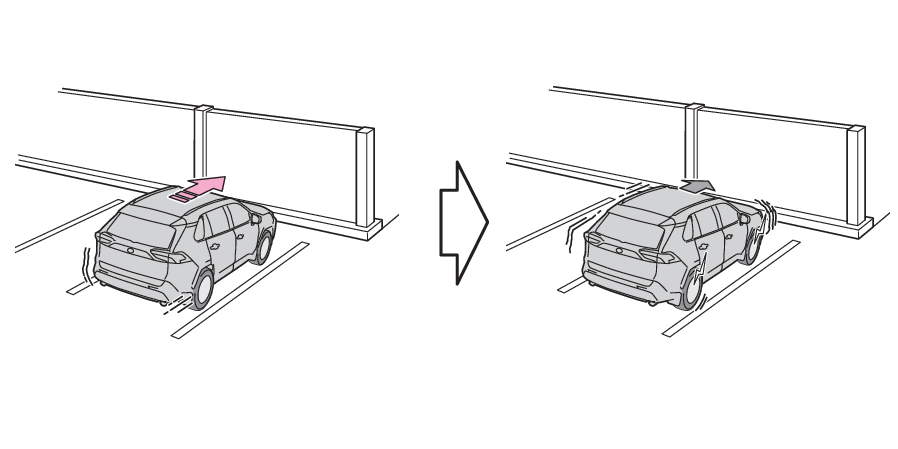
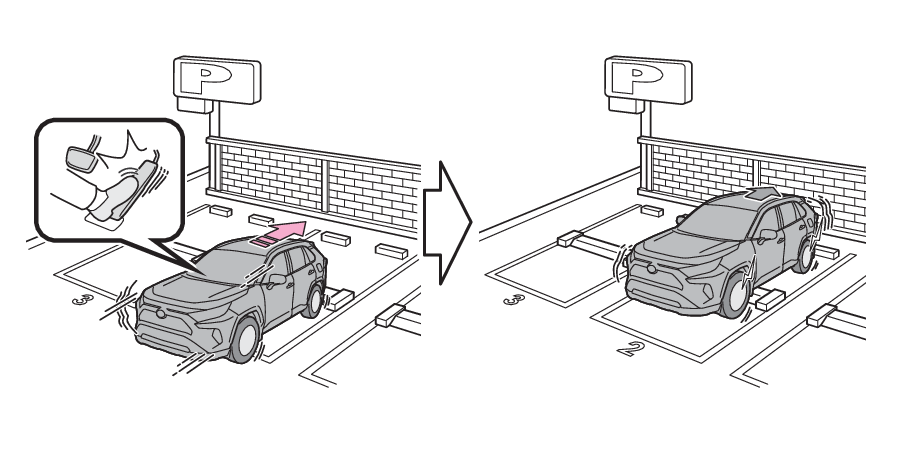
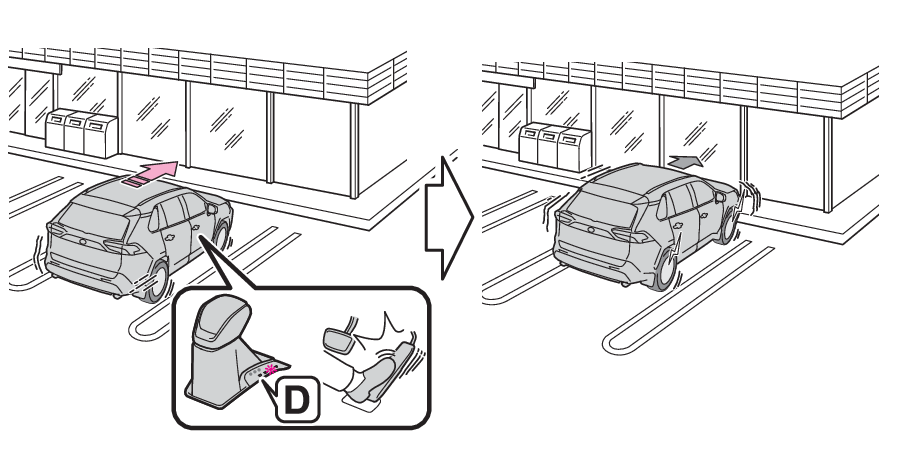
Parking Support Brake function (static objects)Parking Support Brake function (static objects)**If equippedIf the sensors detect a static object, such as a wall, in the traveling direction
of the vehicle and the system determines that a collision may occur due to the vehicle
suddenly moving forward due to an accidental accelerator pedal operation, the vehicle
moving the unintended direction due to the wrong shift position being selected, or
while parking or traveling at low speeds, the system will operate to lessen the impact
with the detected static object and reduce the resulting damage.Examples of function operationThis function will operate in situations such as the following if an object is detected
in the traveling direction of the vehicle.When traveling at a low speed and the brake pedal is not depressed, or is depressed
lateWhen the accelerator pedal is depressed excessivelyWhen the vehicle moves in the unintended direction due to the wrong shift position
being selectedTypes of sensorsSystem componentsWarning:To ensure the Parking Support Brake can operate properlyObserve the following precautions regarding the sensors (System components). Failure to do so may cause a sensor to not operate properly, and may cause an accident.Do not modify, disassemble or paint the sensors.Do not replace a sensor with a part other than a genuine part.Do not subject a sensor or its surrounding area to a strong impact.Do not damage the sensors, and always keep them clean.If the area around a radar sensor is subjected to an impact, the system may not operate
properly due to a sensor malfunction. Have the vehicle inspected by your Toyota dealer.Handling the suspensionDo not modify the suspension, as changes to the height or inclination of the vehicle
may prevent the sensors from detecting objects correctly or cause the system to not
operate or operate unnecessarily.If the Parking Support Brake function (static objects) operates unnecessarily, such
as at a railroad crossingIn the event that the Parking Support Brake function (static objects) operates unnecessarily,
such as at a railroad crossing, brake control will be canceled after approximately
2 seconds, allowing you to proceed forward and leave the area, brake control can also
be canceled by depressing the brake pedal. Depressing the accelerator pedal after
brake control is canceled will allow you to proceed forward and leave the area.Notes when washing the vehicleDo not apply intensive bursts of water or steam to the sensor area.Doing so may result in the sensor malfunctioning.When using a high pressure washer to wash the vehicle, do not spray the sensors directly,
as doing so may cause a sensor to malfunction.When using steam to clean the vehicle, do not direct steam too close to the sensors
as doing so may cause a sensor to malfunction.When to disable the Parking Support BrakeIn the following situations, disable the Parking Support Brake as the system may operate
even though there is no possibility of a collision.When inspecting the vehicle using a chassis roller, chassis dynamo or free rollerWhen loading the vehicle onto a boat, truck or other transport vesselIf the suspension has been modified or tires of a size other than specified are installedIf the front of the vehicle is raised or lowered due to the carried loadWhen equipment that may obstruct a sensor is installed, such as a towing eyelet, bumper
protector (an additional trim strip, etc.), bicycle carrier, or snow plowWhen using an automatic car washNote:The Parking Support Brake function (static object) will operate whenThe function will operate when the PKSB OFF indicator is not illuminated or flashing
(Warning lights, Indicators) and all of the following conditions are met:Engine output restriction controlThe Parking Support Brake is enabled.The vehicle speed is 9 mph (15 km/h) or less.There is a static object in the traveling direction of the vehicle and 6 to 13 ft.
(2 to 4 m) away.The Parking Support Brake determines that a stronger-than-normal brake operation is
necessary to avoid a collision.Brake controlEngine output restriction control is operatingThe Parking Support Brake determines that an immediate brake operation is necessary
to avoid a collision.The Parking Support Brake function (static objects) will stop operating whenThe function will stop operating if any of the following conditions are met:Engine output restriction controlThe Parking Support Brake is disabled.The system determines that the collision has become avoidable with normal brake operation.The static object is no longer 6 to 13 ft. (2 to 4 m) away from the vehicle or in
the traveling direction of the vehicle.Brake controlThe Parking Support Brake is disabled.Approximately 2 seconds have elapsed since the vehicle was stopped by brake control.The brake pedal is depressed after the vehicle is stopped by brake control.The static object is no longer 6 to 13 ft. (2 to 4 m) away from the vehicle or in
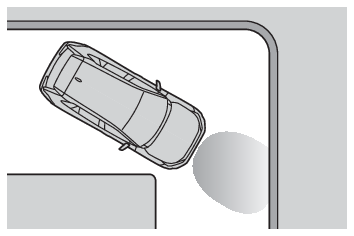
the traveling direction of the vehicle.Detection range of the Parking Support Brake function (static objects)The detection range of the Parking Support Brake function (static objects) differs
from the detection range of the intuitive parking assist. (Sensor detection display, object distance) Therefore, even if the intuitive parking assist detects an object and provides a
warning, the Parking Support Brake function (static objects) may not start operating.Objects that the Parking Support Brake function (static objects) may not detectThe sensors may not be able to detect certain objects, such as the following:PedestrianCotton, snow, and other materials that are poor reflectors of sonic wavesObjects which are not perpendicular to the ground, are not perpendicular to the traveling
direction of the vehicle, are uneven or are wavingLow objectsThin objects such as wires, fences, ropes and signpostsObjects that are extremely close to the bumperSharply-angled objectsTall objects with upper sections projecting outwards in the direction of your vehicleIntuitive parking assist buzzerRegardless of whether the intuitive parking assist system is enabled or not (Turning intuitive parking assist on/off), if the Parking Support Brake function (static objects) is enabled (Enabling/Disabling the Parking Support Brake), the front or rear sensors detect an object and brake control and engine output
restriction control are performed, the intuitive parking assist buzzer will sound
to notify the driver of the approximate distance to the object.Situations in which the Parking Support Brake function (static objects) may operate
even if there is no possibility of a collisionIn some situations, such as the following, the Parking Support Brake function (static
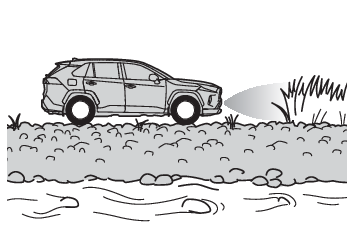
objects) may operate even though there is no possibility of a collision.Vehicle surroundingsWhen driving on a narrow roadWhen driving on a gravel road or in an area with tall grassWhen driving toward a banner, flag, low-hanging branch or boom barrier (such as those
used at railroad crossings, toll gates and parking lots)When there is a structure on the roadside (such as when driving in a narrow tunnel,
on a narrow bridge or on a narrow road)When parallel parkingWhen there is a rut or hole in the surface of the roadWhen driving on a metal cover (grating), such as those used for drainage ditchesWhen driving up or down a steep slopeIf a sensor is hit by a large amount of water, such as when driving on a flooded roadWhen loaded on ships or trucksMoving type automatic car washLift type parking area or multi-story parking lotUnderground parking areaStructures on the ground (speed bumps, cat’s eyes, etc.)Differences in heightWhen moving straight ahead or turning rightSnow-melting pipesDevices for detecting vehicles, such as traffic lights, devices for detecting traffic
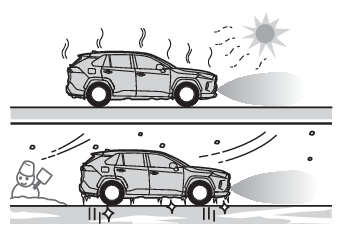
congestion, or devices for detecting empty spaces in parking areasRailroad tracksH-shaped steelWhen there are vehicles on both sides, or there is a vehicle that resembles this vehicleWeatherIf a sensor is covered with ice, snow, dirt, etc. (when cleared, the system will return
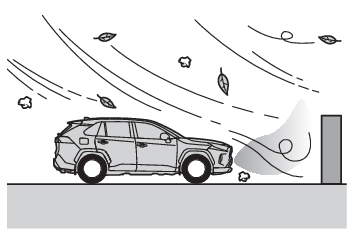
to normal)If heavy rain or water strikes a sensorWhen driving in inclement weather such as fog, snow or a sandstormStrong wind is blowingOther sonic wave sourcesWhen vehicle horns, vehicle detectors, motorcycle engines, air brakes of large vehicles,
the clearance sonar of other vehicles or other devices which produce ultrasonic waves
are near the vehicleIf a sticker or an electronic component, such as a backlit license plate (especially
fluorescent type), fog lights, fender pole or wireless antenna is installed near a
sensorChanges in the vehicle postureIf the vehicle is significantly tiltedIf the front of the vehicle is raised or lowered due to the carried loadIf the orientation of a sensor has been changed due to a collision or other impactSituations in which the Parking Support Brake function (static objects) may not operate
properlyIn some situations, such as the following, this function may not operate properly.WeatherWhen a sensor or the area around a sensor is extremely hot or coldWhen strong winds are blowingIf a sensor is covered with ice, snow, dirt, etc. (when cleared, the system will return
to normal)If heavy rain or water strikes a sensorWhen driving in inclement weather such as fog, snow or a sandstormA sensor is frozen. (Thawing the area will resolve this problem.)Vehicle surroundingsWhen an object that cannot be detected is between the vehicle and a detected objectIf an object such as a vehicle, motorcycle, bicycle or pedestrian cuts in front of
the vehicle or runs out from the side of the vehicleThe vehicle is approaching a tall or curved curb.On an extremely bumpy road, on an incline, on gravel, or on grass.The objects draw too close to the sensor.Other sonic waves sourcesWhen vehicle horns, vehicle detectors, motorcycle engines, air brakes of large vehicles,
the clearance sonar of other vehicles or other devices which produce ultrasonic waves
are near the vehicleIf a sticker or an electronic component, such as a backlit license plate (especially
fluorescent type), fog lights, fender pole or wireless antenna is installed near a
sensorChanges in the vehicleIf the vehicle is significantly tiltedIf the front of the vehicle is raised or lowered due to the carried loadIf the orientation of a sensor has been changed due to a collision or other impactWhen equipment that may obstruct a sensor is installed, such as a towing eyelet, bumper
protector (an additional trim strip, etc.), bicycle carrier, or snow plowIf the suspension has been modified or tires of a size other than specified are installedIf paint or a sticker is applied to the sensorWhen the shift lever is in N