OverheatingEmergency, in case of
If your vehicle overheatsEngine
OverheatingCooling system
Engine overheatingIf your vehicle overheatsThe following may indicate that your vehicle is overheating.The engine coolant temperature gauge (Gauges and meters (7-inch display), Gauges and meters (12.3-inch display)) is in the red zone or a loss of hybrid system power is experienced. (For example,
the vehicle speed does not increase.)“Engine Coolant Temp High Stop in a Safe Place See Owner’s Manual” or “Hybrid System
Overheated Output Power Reduced” is shown on the multi-information display.Steam comes out from under the hood.Correction proceduresIf the engine coolant temperature gauge enters the red zone or “Engine Coolant Temp
High Stop in a Safe Place See Owner’s Manual” is shown on the multi-information displayStop the vehicle in a safe place and turn off the air conditioning system, and then
stop the hybrid system.If you see steam:Carefully lift the hood after the steam subsides.If you do not see
steam:Carefully lift the hood.After the hybrid system has cooled down sufficiently, inspect the hoses and radiator
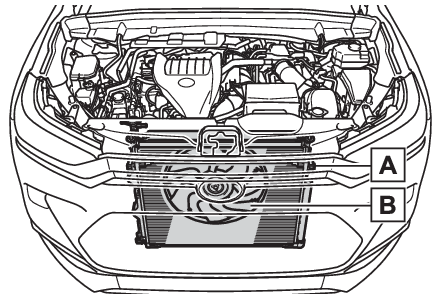
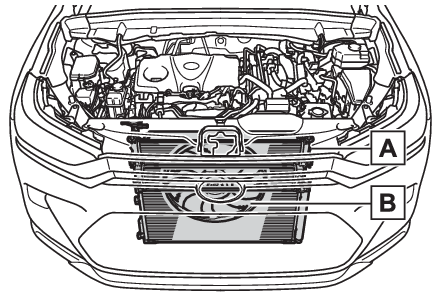
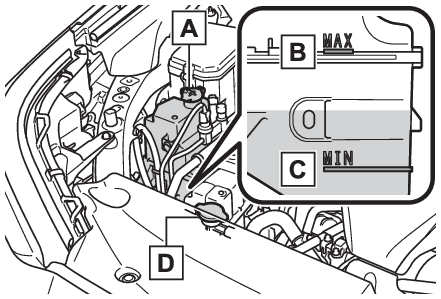
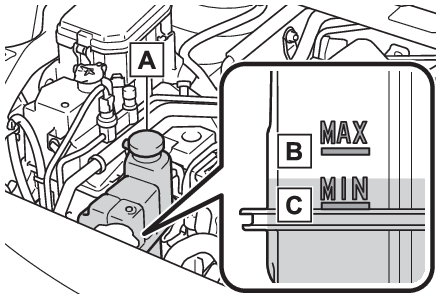
core (radiator) for any leaks.Vehicles with 2.4L 4-cylinder (T24A-FTS) engineRadiatorCooling fanIf a large amount of coolant leaks, immediately contact your Toyota dealer.Vehicles with 2.5L 4-cylinder (A25A-FXS) engineRadiatorCooling fanIf a large amount of coolant leaks, immediately contact your Toyota dealer.The coolant level is satisfactory if it is between the “MAX” and “MIN” lines on the
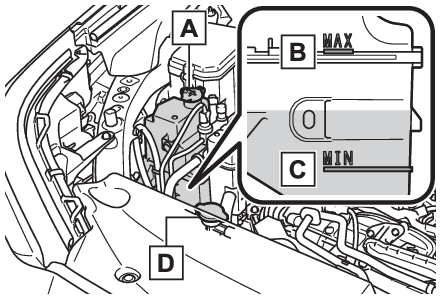
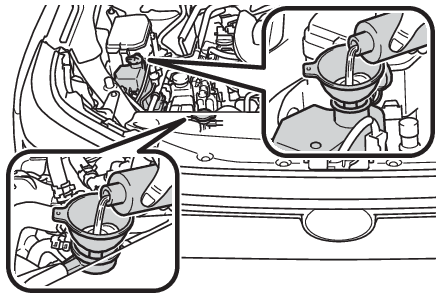
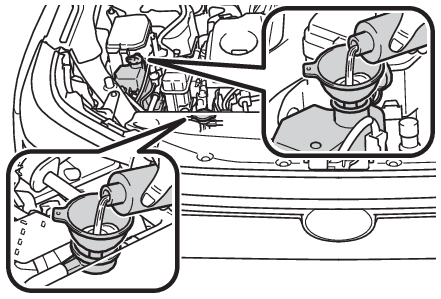
reservoir.Engine (vehicles with 2.4L 4-cylinder [T24A-FTS] engine)Reservoir“MAX” line“MIN” lineRadiator capEngine (vehicles with 2.5L 4-cylinder [A25A-FXS] engine)Reservoir“MAX” line“MIN” lineRadiator capIntercooler (vehicles with 2.4L 4-cylinder [T24A-FTS] engine only)Reservoir“MAX” line“MIN” lineAdd coolant if necessary.Water can be used in an emergency if coolant is unavailable.Engine (vehicles with 2.4L 4-cylinder [T24A-FTS] engine)Engine (vehicles with 2.5L 4-cylinder [A25A-FXS] engine)Intercooler (vehicles with 2.4L 4-cylinder [T24A-FTS] engine only)Start the hybrid system and turn the air conditioning system on to check that the
radiator cooling fan operate and to check for coolant leaks from the radiator or hoses.The fan operate when the air conditioning system is turned on immediately after a
cold start. Confirm that the fan is operating by checking the fan sound and air flow.
If it is difficult to check these, turn the air conditioning system on and off repeatedly.
(The fan may not operate in freezing temperatures.)If the fan is not operating:Stop the hybrid system immediately and contact your Toyota
dealer.If the fan is operating:Have the vehicle inspected at the nearest Toyota dealer.Check if “Engine Coolant Temp High Stop in a Safe Place See Owner’s Manual” is shown
on the multi-information display.If the message does not disappear:Stop the hybrid system and contact your Toyota dealer.If
the message is not displayed:Have the vehicle inspected at the nearest Toyota dealer.Hybrid system
OverheatingCooling system
Hybrid system overheatingIf “Hybrid System Overheated Output Power Reduced” is shown on the multi-information
displayStop the vehicle in a safe place.Stop the hybrid system and carefully lift the hood.After the hybrid system has cooled down, inspect the hoses and radiator core (radiator)
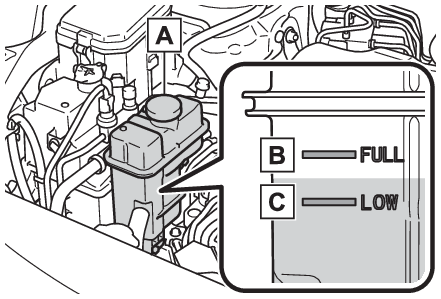
for any leaks.Vehicles with 2.4L 4-cylinder (T24A-FTS) engineRadiatorCooling fanIf a large amount of coolant leaks, immediately contact your Toyota dealer.Vehicles with 2.5L 4-cylinder (A25A-FXS) engineRadiatorCooling fanIf a large amount of coolant leaks, immediately contact your Toyota dealer.The coolant level is satisfactory if it is between the “MAX”/“FULL” and “MIN”/“LOW”
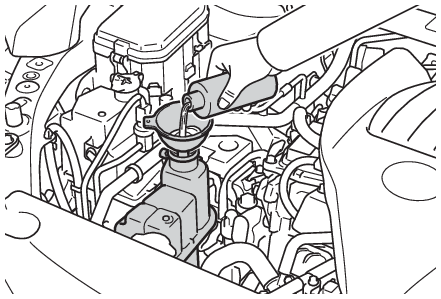
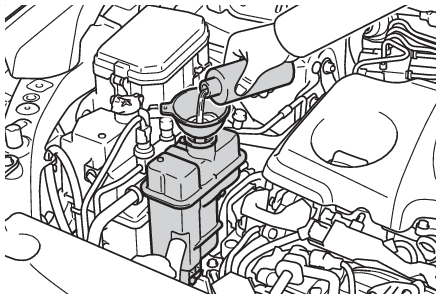
lines on the reservoir.Vehicles with 2.4L 4-cylinder (T24A-FTS) engineReservoir“MAX” line“MIN” lineVehicles with 2.5L 4-cylinder (A25A-FXS) engineReservoir“FULL” line“LOW” lineAdd coolant if necessary.Water can be used in an emergency if coolant is unavailable.Vehicles with 2.4L 4-cylinder (T24A-FTS) engineVehicles with 2.5L 4-cylinder (A25A-FXS) engineStart the hybrid system and check if “Hybrid System Overheated Output Power Reduced”
is shown on the multi-information display.If the message does not disappear:Stop the
hybrid system and contact your Toyota dealer.If the message is not displayed:Have
the vehicle inspected at the nearest Toyota dealer.Warning:When inspecting under the hood of your vehicleObserve the following precautions.Failure to do so may result in serious injury such
as burns.If steam is seen coming from under the hood, do not open the hood until the steam
has subsided. The engine compartment may be very hot.Vehicles with 2.5L 4-cylinder (A25A-FXS) engine: After the hybrid system has been
turned off, check that the “READY” indicator is off.When the hybrid system is operating,
the gasoline engine may automatically start, or the cooling fan may suddenly operate
even if the gasoline engine stops. Do not touch or approach rotating parts such as
the fan, which may lead to fingers or clothing (especially a tie, a scarf or a muffler)
getting caught, resulting in serious injury.Vehicles with 2.4L 4-cylinder (T24A-FTS) engine: After the hybrid system has been
turned off, check that the “READY” indicator is off.When the hybrid system is operating,
the gasoline engine may automatically start, or the cooling fan may suddenly operate
even if the gasoline engine stops. Also, the cooling fan may operate for a while after
turning off the hybrid system. Do not touch or approach rotating parts such as the
fan, which may lead to fingers or clothing (especially a tie, a scarf or a muffler)
getting caught, resulting in serious injury.Do not loosen the radiator cap and the coolant reservoir caps while the hybrid system
and radiator are hot.High temperature steam or coolant could spray out.Notice:When adding engine/power control unit coolantAdd coolant slowly after the hybrid system has cooled down sufficiently. Adding cool
coolant to a hot hybrid system too quickly can cause damage to the hybrid system.To prevent damage to the cooling systemObserve the following precautions:Avoid contaminating the coolant with foreign matter (such as sand or dust, etc.).Do not use any coolant additive.