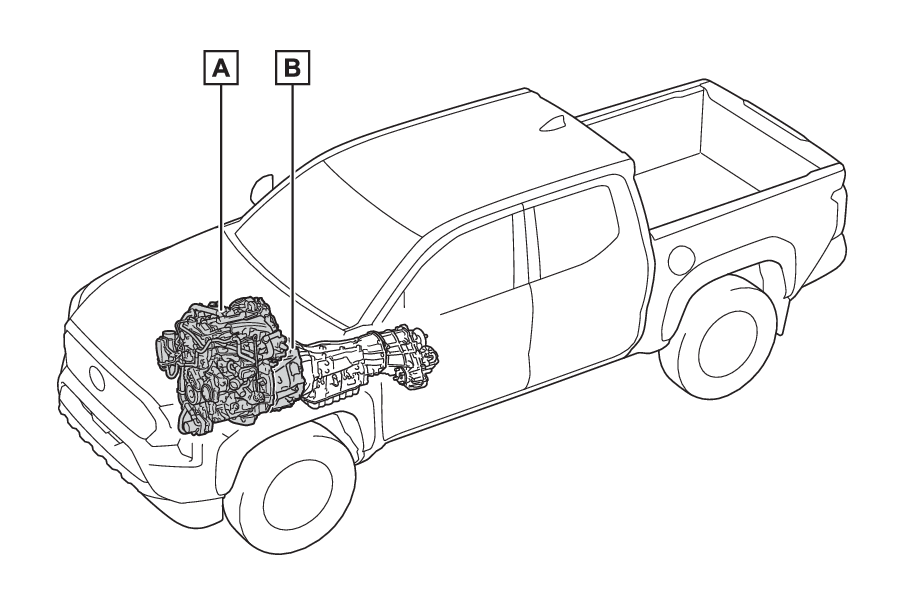
Traction motor (electric motor)Hybrid systemElectric motor (traction motor)Hybrid system featuresYour vehicle is a Hybrid Electric Vehicle. It has characteristics different from conventional
vehicles. Be sure you are closely familiar with the characteristics of your vehicle,
and operate it with care.The hybrid system combines the use of a gasoline engine and an electric motor (traction
motor) according to driving conditions, improving fuel efficiency and reducing exhaust
emissions.System componentsSystem componentsThe illustration is an example for explanation and may differ from the actual item.Gasoline engineElectric motor (traction motor)When stopped/during start offThe gasoline engine stops* when the vehicle is stopped. During start off, the electric motor (traction motor)
drives the vehicle. At slow speeds or when traveling down a gentle slope, the engine
is stopped* and the electric motor (traction motor) is used.*When the hybrid battery (traction battery) requires charging or the engine is warming
up, etc., the gasoline engine will not automatically stop. (Conditions in which the gasoline engine may not stop)During normal drivingThe gasoline engine is predominantly used. The electric motor (traction motor) charges
the hybrid battery (traction battery) as necessary.When accelerating sharplyWhen the accelerator pedal is depressed heavily, the power of the hybrid battery (traction
battery) is added to that of the gasoline engine via the electric motor (traction
motor).Regenerative brakingWhen braking (regenerative braking)The wheels operate the electric motor (traction motor) as a power generator, and the
hybrid battery (traction battery) is charged.Note:Hybrid system
Regenerative brakingBrake
Regenerative brakingRegenerative brakingIn the following situations, kinetic energy is converted to electric energy and deceleration
force can be obtained in conjunction with the recharging of the hybrid battery (traction
battery).The accelerator pedal is released while driving with the shift lever in D or S.The brake pedal is depressed while driving with the shift lever in D or S.Conditions in which the gasoline engine may not stopThe gasoline engine starts and stops automatically. However, it may not stop automatically
in the following conditions:During gasoline engine warm-upDuring hybrid battery (traction battery) chargingWhen the temperature of the hybrid battery (traction battery) is high or lowWhen the heater is switched onWhen the “
TOW HAUL” switch is onWhen the “
MTS” switch is onVehicles with part-time 4WD: When the front-wheel drive control switch is in “
4H” or “
4L”Vehicles with full-time 4WD: When the front-wheel drive control switch is in “
H4L” or “
L4L”When the hood is opened during “
READY” indicator is illuminatedWhen the shift lever is shifted to SDepending on the circumstances, the gasoline engine may also not stop automatically
in other situations.Charging the hybrid battery (traction battery)As the gasoline engine charges the hybrid battery (traction battery), the battery
does not need to be charged from an outside source. However, if the vehicle is left
parked for a long time the hybrid battery (traction battery) will slowly discharge.
For this reason, be sure to drive the vehicle at least once every few months for at
least 30 minutes or 10 miles (16 km). If the hybrid battery (traction battery) becomes
fully discharged and you are unable to start the hybrid system, contact your Toyota
dealer.Charging the 12-volt batteryCharging the 12-volt batteryAfter the 12-volt battery has discharged or when the terminal has been removed and
installed during exchange, etc.The gasoline engine may not stop even if the vehicle is being driven by the hybrid
battery (traction battery). If this continues for a few days, contact your Toyota
dealer.Sounds and vibrations specific to a Hybrid Electric VehicleThere may be no engine sound or vibration even though the vehicle is able to move
with the “
READY” indicator is illuminated. For safety, apply the parking brake and make sure to shift
the shift lever to P when parked.The following sounds or vibrations may occur when the hybrid system is operating and
are not a malfunction:Motor sounds may be heard from the engine compartment.Sounds may be heard from the hybrid battery (traction battery) under the rear seats
when the hybrid system starts or stops.Relay operating sounds such as a snap or soft clank will be emitted from the hybrid
battery (traction battery), under the rear seats, when the hybrid system is started
or stopped.Sounds may be heard from the transmission when the gasoline engine starts or stops,
when driving at low speeds, or during idling.Engine sounds may be heard when accelerating sharply.Sounds may be heard due to regenerative braking when the brake pedal is depressed
or as the accelerator pedal is released.Vibration may be felt when the gasoline engine starts or stops.Cooling fan sounds may be heard from the air intake vents on the side of the lower
part of the rear seat.Maintenance, repair, recycling, and disposalContact your Toyota dealer regarding maintenance, repair, recycling and disposal.
Do not dispose of the vehicle yourself.Acoustic vehicle alerting systemHybrid system
Acoustic vehicle alerting systemAcoustic vehicle alerting systemWhen the gasoline engine is off while driving, a sound is produced to warn pedestrians,
people riding bicycles or other people and vehicles in the surrounding area that the
vehicle is approaching. The pitch of the sound adjusts according to vehicle speed.
When vehicle speed is approximately 22 mph (35 km/h) or more, the warning system turns
off.Note:Acoustic vehicle alerting systemIn the following cases, the acoustic vehicle alerting system sound may be difficult
for pedestrians, people riding bicycles or other people and vehicles in the surrounding
area to hear:When there is a lot of noise in the vicinityWhen it is raining or during strong winds