Emergency, in case of
If you have a flat tireFlat tire
Vehicles with a spare tireReplacing
TiresSpare tireTires
If you have a flat tireTires
ReplacingTires
Spare tireIf you have a flat tire (vehicles with a spare tire)Your vehicle is equipped with a spare tire. The flat tire can be replaced with the
spare tire.For details about tires: TiresWarning:If you have a flat tireDo not continue driving with a flat tire. Driving even a short distance with a flat
tire can damage the tire and the wheel beyond repair, which could result in an accident.Before jacking up the vehicleStop the vehicle in a safe place on a hard, flat surface.Set the parking brake.Shift the shift lever to P (continuously variable transmission) or R (manual transmission).Stop the engine.Turn on the emergency flashers.Jack
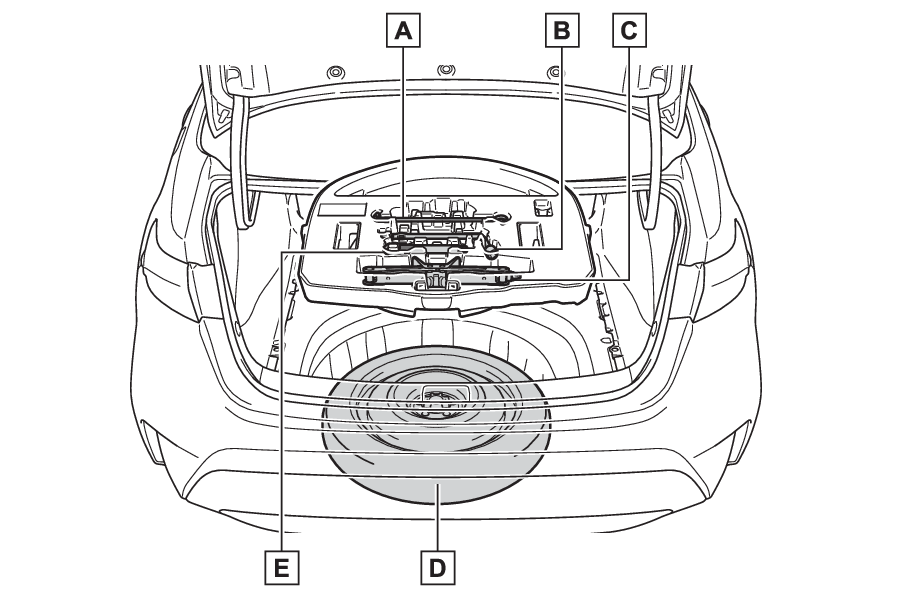
Vehicle-equipped jackJack handleToolsSpare tire
Storage locationLocation of the spare tire, jack and toolsJack handleWheel nut wrenchJackSpare tireTowing eyelet (if equipped)Warning:Using the tire jackObserve the following precautions. Improper use of the tire jack may cause the vehicle
to suddenly fall off the jack, leading to death or serious injury.Do not use the tire jack for any purpose other than replacing tires or installing
and removing tire chains.Only use the tire jack that comes with this vehicle for replacing a flat tire. Do
not use it on other vehicles, and do not use other tire jacks for replacing tires
on this vehicle.Put the jack properly in its jack point.Do not put any part of your body under the vehicle while it is supported by the jack.Do not start the engine or drive the vehicle while the vehicle is supported by the
jack.Do not raise the vehicle while someone is inside.When raising the vehicle, do not put an object on or under the jack.Do not raise the vehicle to a height greater than that required to replace the tire.Use a jack stand if it is necessary to get under the vehicle.When lowering the vehicle, make sure that there is no-one near the vehicle. If there
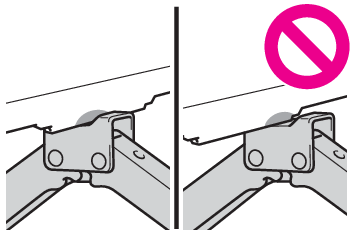
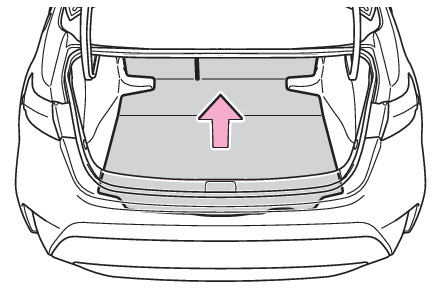
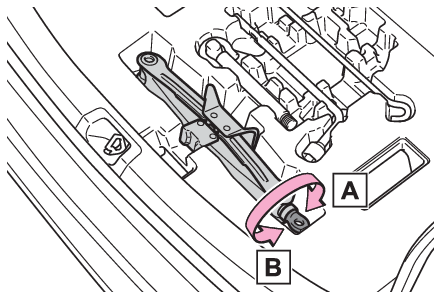
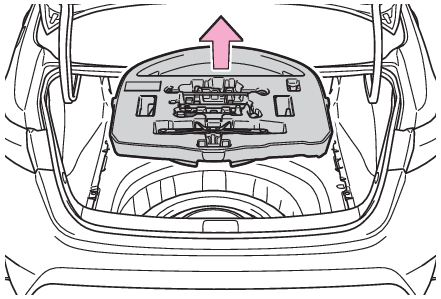
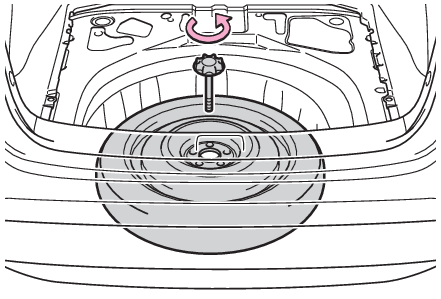
are people nearby, warn them vocally before lowering.Taking out the jackRemove the deck mat.Take out the jack.For tighteningFor looseningTaking out the spare tireRemove the deck mat. (If you have a flat tire (vehicles with a spare tire))Remove the tool tray.Loosen the center fastener that secures the spare tire.Warning:When storing the spare tireBe careful not to catch fingers or other body parts between the spare tire and the
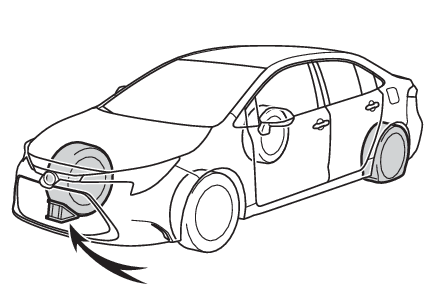
body of the vehicle.Replacing a flat tireChock the tires.
Flat tire
Wheel chock positions
Front left-hand side
Behind the rear right-hand side tire
Front right-hand side
Behind the rear left-hand side tire
Rear left-hand side
In front of the front right-hand side tire
Rear right-hand side
In front of the front left-hand side tire
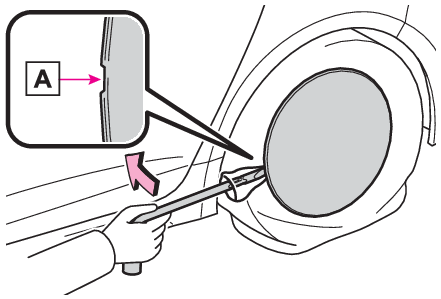
Vehicles with a steel wheel: Remove the wheel ornament (if equipped) using the wrench.Insert the wrench into the notch
on the wheel cap.To protect the wheel ornament, place a rag between the wrench and
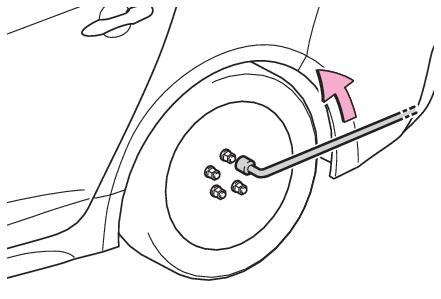
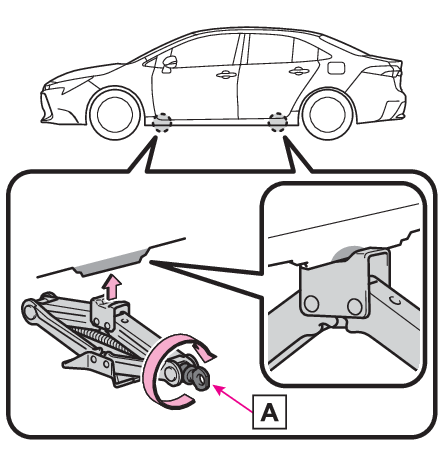
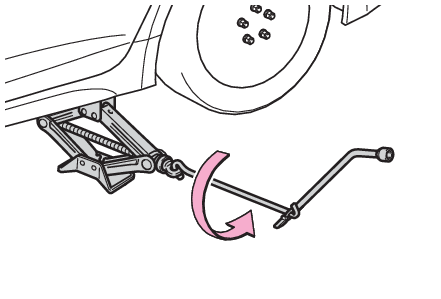
the wheel ornament.Slightly loosen the wheel nuts (one turn).Turn the tire jack portion
by hand until the center of the recessed portion of the jack is in contact with the
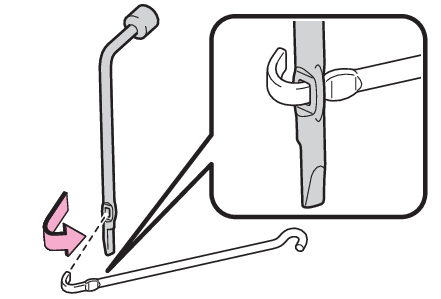
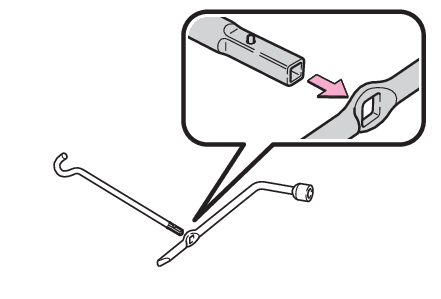
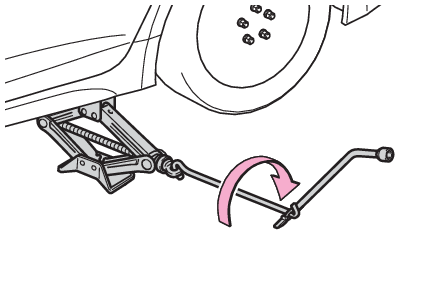
center of the jack point.Assemble the jack handle extension.Type AType BRaise the vehicle until the tire is slightly raised off the ground.Remove all the wheel nuts and the tire.When resting the tire on the ground, place the tire so that the wheel design faces
up to avoid scratching the wheel surface.Warning:Replacing a flat tireDo not touch the disc wheels or the area around the brakes immediately after the vehicle
has been driven. After the vehicle has been driven the disc wheels and the area around
the brakes will be extremely hot. Touching these areas with hands, feet or other body
parts while changing a tire, etc. may result in burns.Failure to follow these precautions could cause the wheel nuts to loosen and the tire
to fall off, resulting in death or serious injury.Have the wheel nuts tightened with a torque wrench to 76 ft•lbf (103 N•m, 10.5 kgf•m)
as soon as possible after changing wheels.Do not attach a heavily damaged wheel ornament, as it may fly off the wheel while
the vehicle is moving.When installing a tire, only use wheel nuts that have been specifically designed for
that wheel.If there are any cracks or deformations in the bolt screws, nut threads or bolt holes
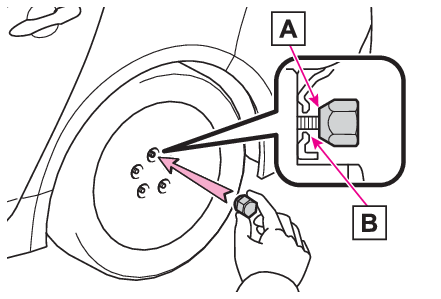
of the wheel, have the vehicle inspected by your Toyota dealer.When installing the wheel nuts, be sure to install them with the tapered ends facing
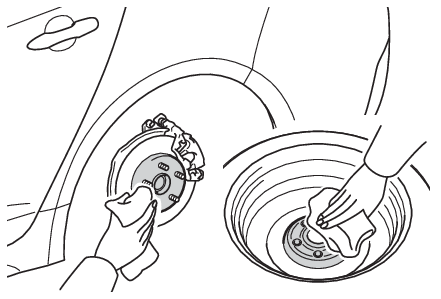
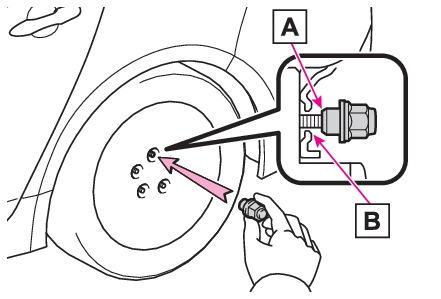
inward. (When installing the wheel nuts)Installing the spare tireRemove any dirt or foreign matter from the wheel contact surface.If foreign matter is on the wheel contact surface, the wheel nuts may loosen while
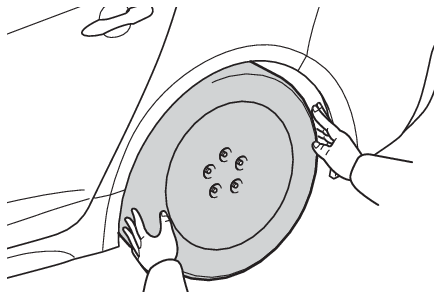
the vehicle is in motion, causing the tire to come off.Install the tire and loosely tighten each wheel nut by hand by approximately the same
amount.When replacing a steel wheel with a steel wheel (including a compact spare tire),
tighten the wheel nuts until the tapered portion
comes into loose contact with the disc wheel seat
.When replacing an aluminum wheel with a steel wheel (including a compact spare tire),
tighten the wheel nuts until the tapered portion
comes into loose contact with the disc wheel seat
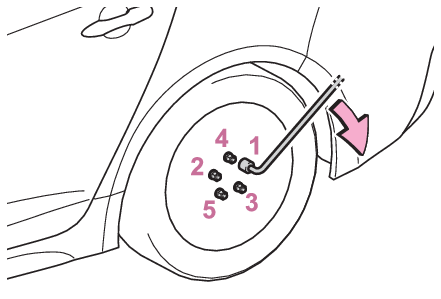
.Lower the vehicle.Firmly tighten each wheel nut two or three times in the order shown in the illustration.Tightening torque:76 ft•lbf (103 N•m, 10.5 kgf•m)Stow the flat tire, tire jack and all tools.Note:The compact spare tireThe compact spare tire is identified by the label “
TEMPORARY USE ONLY” on the tire sidewall. Use the compact spare tire temporarily, and only in an emergency.Make sure to check the tire inflation pressure of the compact spare tire. (Tires and wheels)When the compact spare tire is equippedThe vehicle becomes lower when driving with the compact spare tire compared to when
driving with standard tires.After completing the tire change (vehicles with a tire pressure warning system)The tire pressure warning system must be reset. (Initializing the tire pressure warning system (if equipped))When using the compact spare tire (vehicles with a tire pressure warning system)As the compact spare tire is not equipped with a tire pressure warning valve and transmitter,
low inflation pressure of the spare tire will not be indicated by the tire pressure
warning system. Also, if you replace the compact spare tire after the tire pressure
warning light comes on, the light remains on.If you have a flat front tire on a road covered with snow or iceInstall the compact spare tire on one of the rear wheels of the vehicle. Perform the
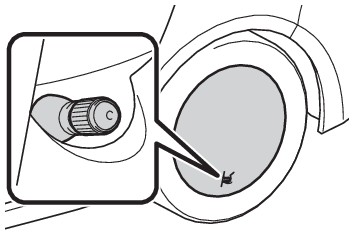
following steps and fit tire chains to the front tires:Replace a rear tire with the compact spare tire.Replace the flat front tire with the tire removed from the rear of the vehicle.Fit tire chains to the front tires.When reinstalling the wheel ornament (steel wheels except compact spare tire)Align the cutout of the wheel ornament with the valve stem as shown in the illustration.Warning:When using the compact spare tireRemember that the compact spare tire provided is specifically designed for use with
your vehicle. Do not use your compact spare tire on another vehicle.Do not use more than one compact spare tires simultaneously.Replace the compact spare tire with a standard tire as soon as possible.Avoid sudden acceleration, abrupt steering, sudden braking and shifting operations
that cause sudden engine braking.When the compact spare tire is attachedThe vehicle speed may not be correctly detected, and the following systems may not
operate correctly:ABS & Brake assistVSCTRACAutomatic High BeamAFS (Adaptive Front-lighting System) (if equipped)Dynamic radar cruise control with full-speed range (if equipped)Dynamic radar cruise control (if equipped)EPSPCS (Pre-Collision System)LDA (Lane Departure Alert with steering control) (if equipped)LTA (Lane Tracing Assist) (if equipped)Tire pressure warning system (if equipped)BSM (Blind Spot Monitor) (if equipped)Rear view monitor systemNavigation system (if equipped)Speed limit when using the compact spare tireDo not drive at speeds in excess of 50 mph (80 km/h) when a compact spare tire is
installed on the vehicle.The compact spare tire is not designed for driving at high speeds. Failure to observe
this precaution may lead to an accident causing death or serious injury.After using the tools and jackBefore driving, make sure all the tools and jack are securely in place in their storage
location to reduce the possibility of personal injury during a collision or sudden
braking.Notice:Be careful when driving over bumps with the compact spare tire installed on the vehicle.The vehicle becomes lower when driving with the compact spare tire compared to when
driving with standard tires. Be careful when driving over uneven road surfaces.Driving with tire chains and the compact spare tireDo not fit tire chains to the compact spare tire. Tire chains may damage the vehicle
body and adversely affect driving performance.When replacing the tires (vehicles with a tire pressure warning system)When removing or fitting the wheels, tires or the tire pressure warning valve and
transmitter, contact your Toyota dealer as the tire pressure warning valve and transmitter
may be damaged if not handled correctly.To avoid damage to the tire pressure warning valves and transmitters (vehicles with
a tire pressure warning system)When a tire is repaired with liquid sealants, the tire pressure warning valve and
transmitter may not operate properly. If a liquid sealant is used, contact your Toyota
dealer or other qualified service shop as soon as possible. Make sure to replace the
tire pressure warning valve and transmitter when replacing the tire.